Jump to a section
A few questions
The quiz takes about a minute. Goal: hypertrophy, strength, both, or general fitness, which covers fat loss, health and a habit. Experience: newer to lifting, intermediate, or advanced. Days a week, and which days. Session length: 30, 45, 60 or 75 minutes, with warm-up on top. Equipment: full gym, barbell at home, dumbbells only, or bodyweight.
A focus if you want one: balanced, booty builder, upper body, arms and delts, or legs all-round. Anything to go easy on: shoulders, lower back, knees, elbows and wrists, hips. Anything to avoid, in your own words. And the split: full body, upper and lower, push, pull and legs, or let Coach choose from your training days.
If the sets your goal needs do not fit the minutes you gave, the quiz says so before anything is written. Then it shows you a full example week, by weekday.
Two of the quiz’s steps
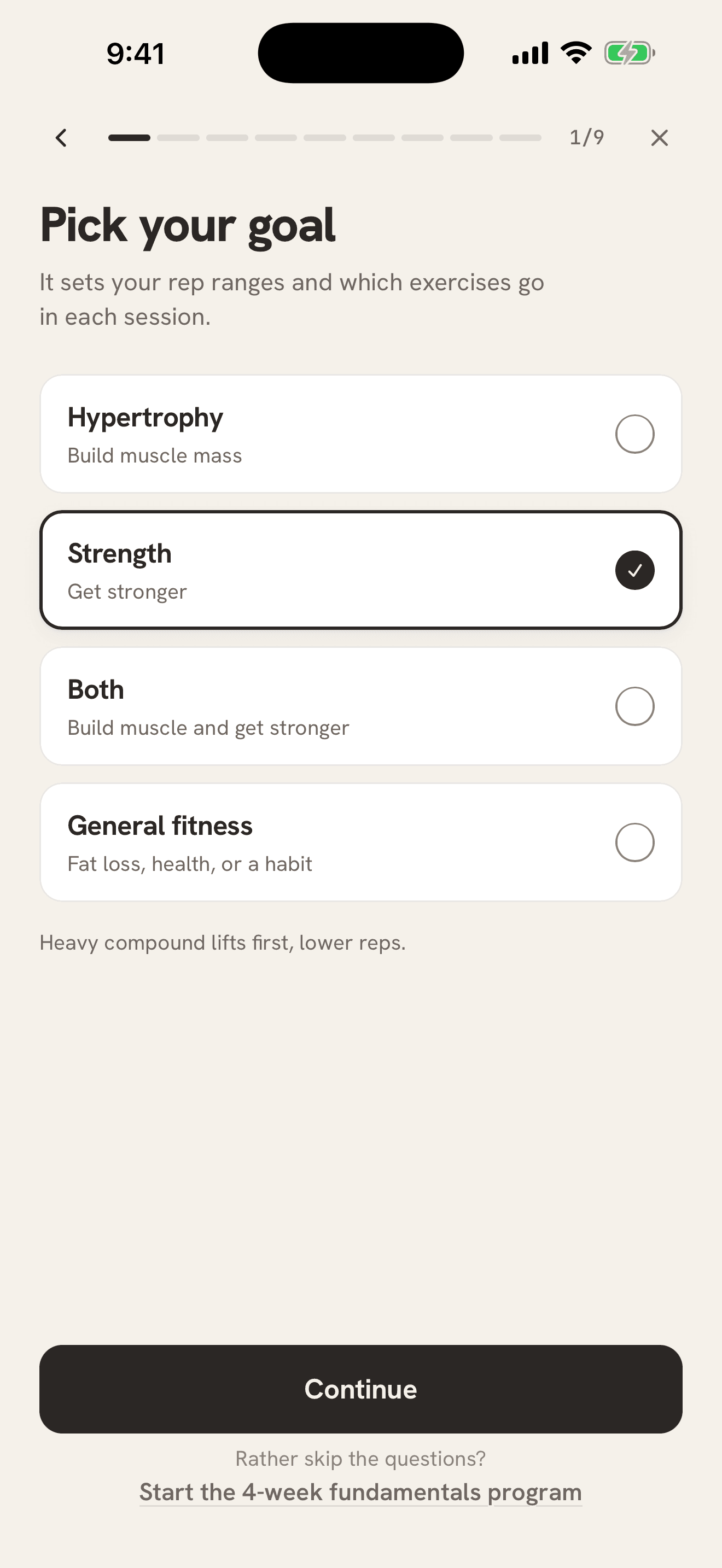
The first step: what the block is for.
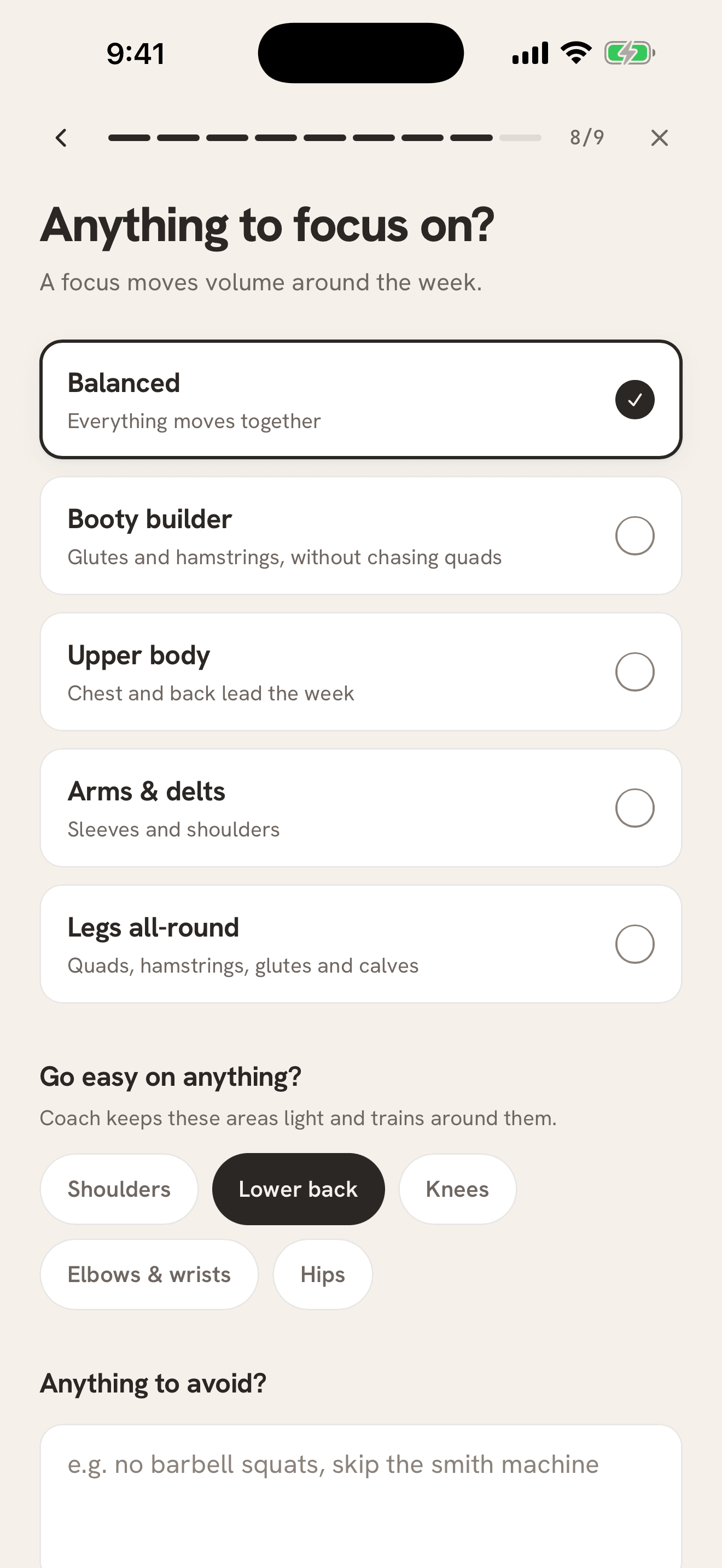
The focus step: where the week leans, what to go easy on, and anything to avoid.
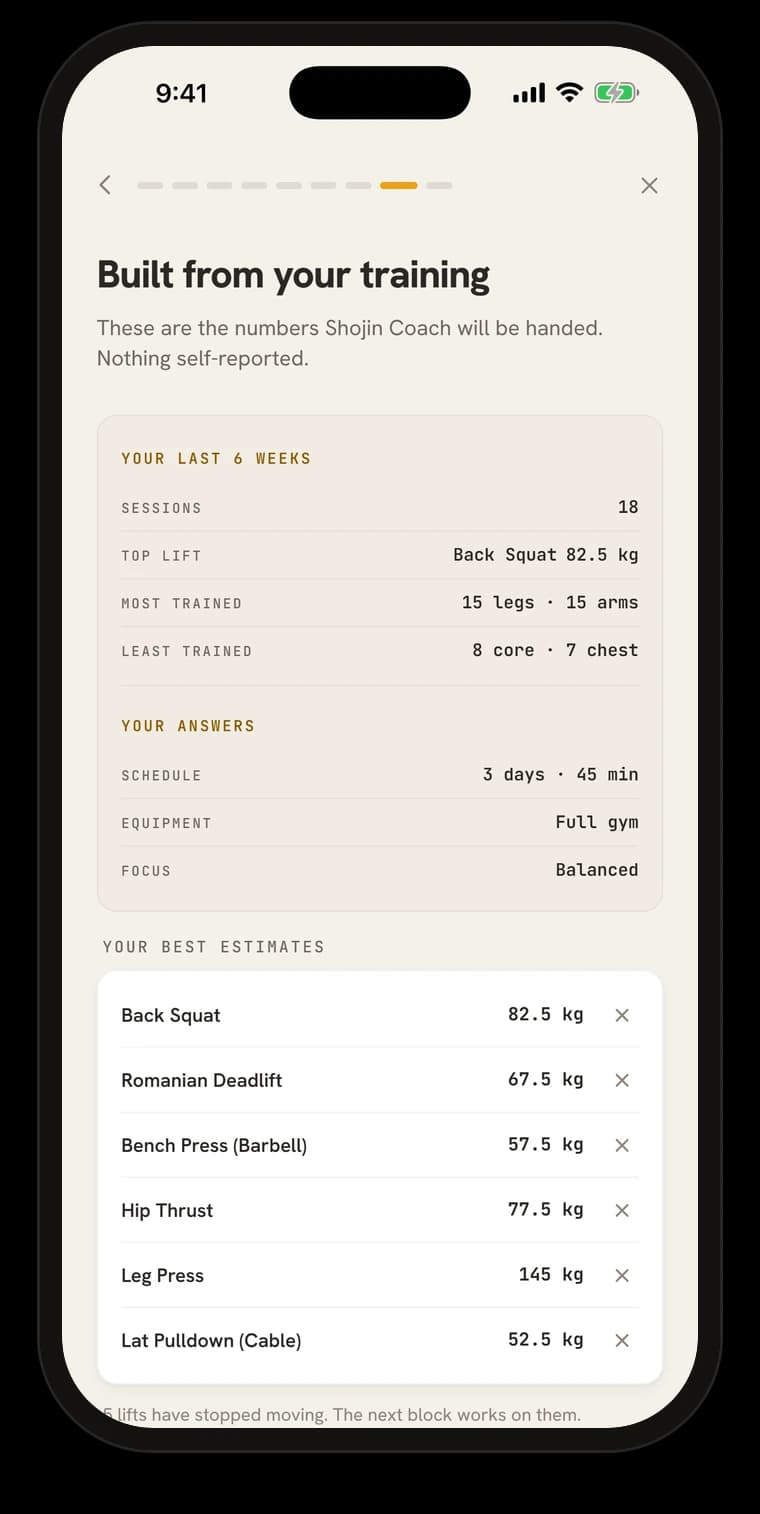
Built from your training
Before it writes anything, Coach reads what you have already logged: how many sessions, your top lift, the muscles you train most and least, and how much you actually do in a week. The review screen shows you those numbers, so you can see what the program is built on. Nothing is self-reported.
A lift you have logged in the last 90 days starts at a percentage of your projected one-rep max, worked out from your best recent sessions and adjusted for time off. A lift you have not logged, or not for 90 days, opens with an empty box and Coach’s guide to a starting load, taken from a related lift. Your first logged set sets the weight. On machines and cables, loads land on the steps you have logged on that stack.
A session, before you start it
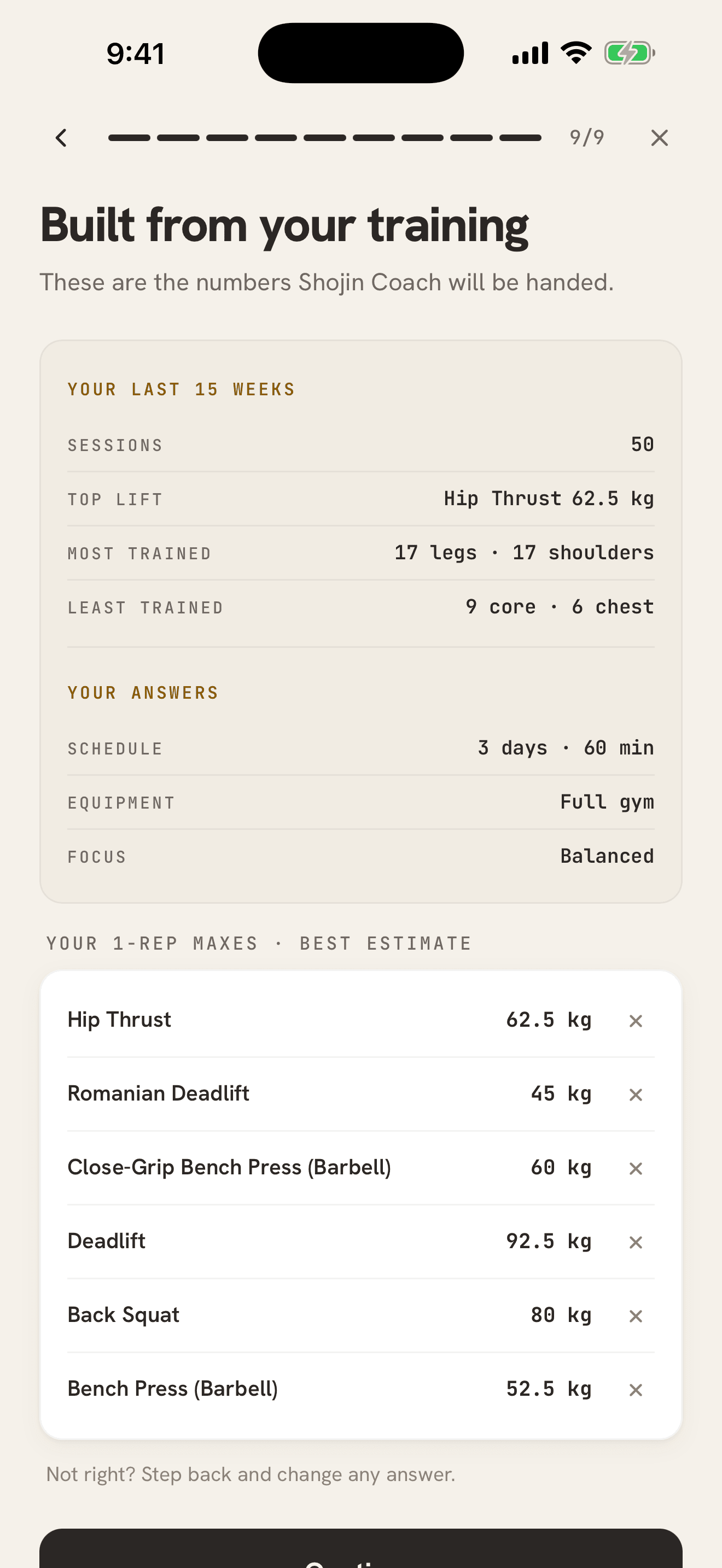
The numbers Coach is handed, on screen before anything is written.
A block, week by week
A block runs four, six, eight or twelve weeks, and you pick the length in the quiz or leave it to Coach, with one session for each day you train. Days are named by what they train, so a day reads Full Body A, squat lead, or Upper A, never day three. Progression is double progression: your reps climb from the bottom of a range to the top, then the load goes up one step and the reps start again. The target effort stays the same all block, RPE 8 on free-weight and bodyweight compound lifts and RPE 9 on machines, cables and single-joint lifts. Deload weeks sit at week eight, or at six and twelve on a longer block. A four or six week block has none, because it ends before the fatigue a deload is for has built up.
Every session lands on your calendar in the Program tab and opens in the logger with your weights already in the boxes. When the block ends, the next program you start picks up from the numbers you just lifted.
The block on the calendar
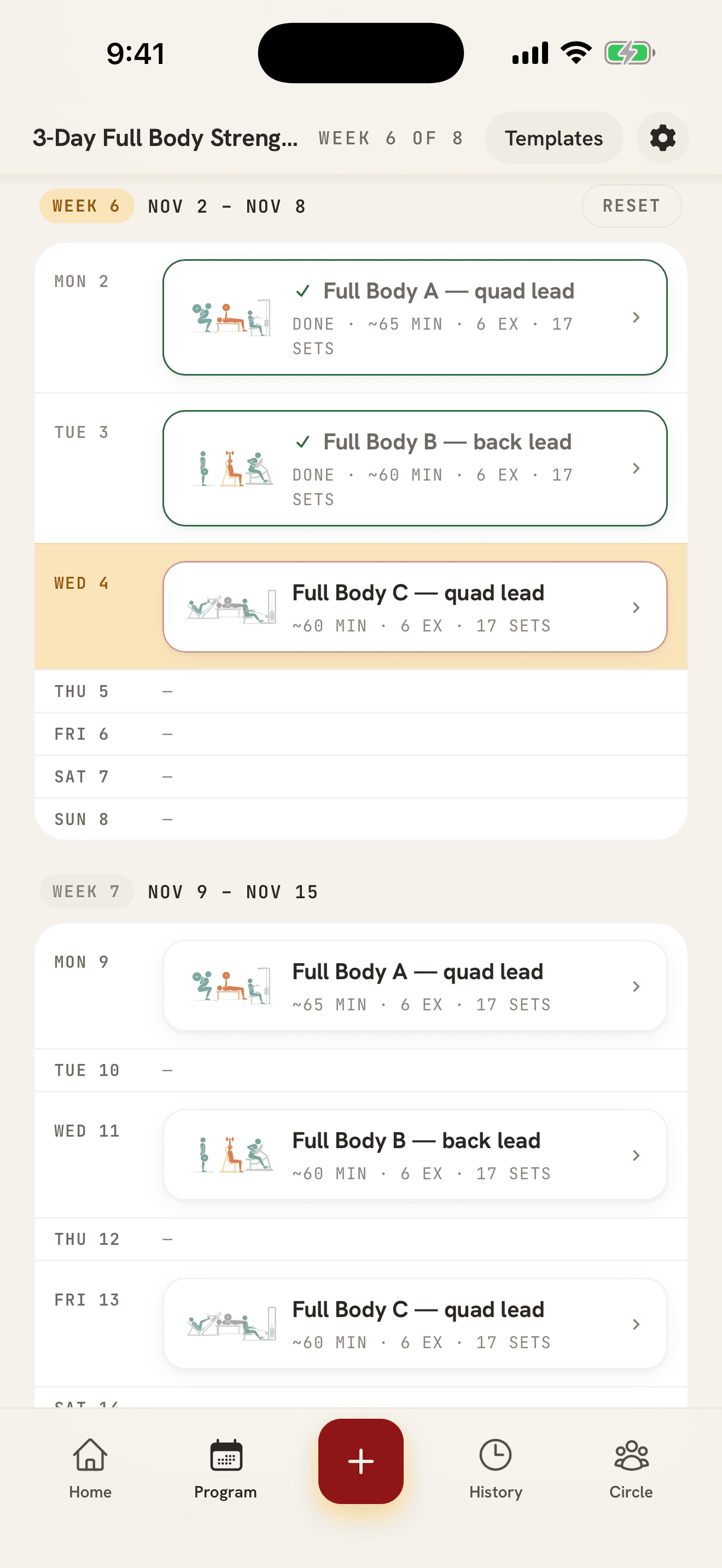
The block on the calendar, week by week.
When you finish the block, Shojin shows what it added up to: the sessions you did against the sessions planned, your new records, and how far each main lift moved from the first week to the last. Past programs keep their summary in the Program tab.
When the block ends
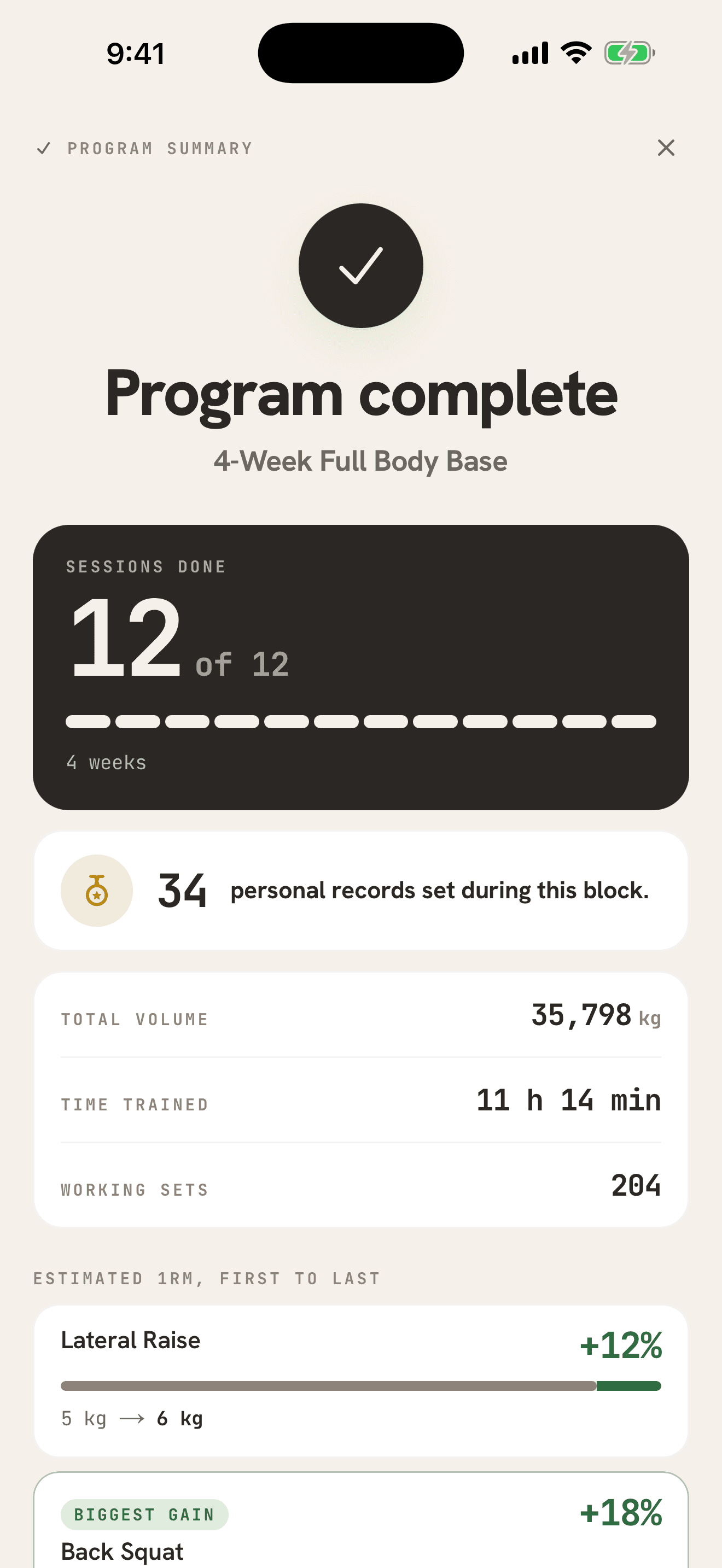
The summary of a finished block: sessions, records, and every main lift from first week to last.
It adjusts to every session you log
Log your sets and the next session moves. Hit the rep target on every set and the target goes up a rep. Reach the top of the range on every set, with none at RPE 10, and the load goes up one step while the reps start again. A set below the range, or one logged one and a half RPE points or more over its target, steps that lift down one increment. Each time you open a session, Coach also checks its loads against what you have lifted lately and moves them to match, within set limits.
In the rest gap, Coach speaks up too. A set that lands well off its target gets a line on the rest card, naming the load for the sets still to come. Set 2 was RPE 10 against a target of 8. Drop the next sets to 47.5 kg. One tap applies it.
After three sessions or a week, Coach asks how the program fits: feels right, too hard, too easy, or change something bigger. Too hard or too easy shifts every remaining session one increment, with an undo.
Swap any exercise for one your gym has. Replacements are ranked by movement pattern, then muscle, then group, with lifts you have logged first.
The logger on a Coach session
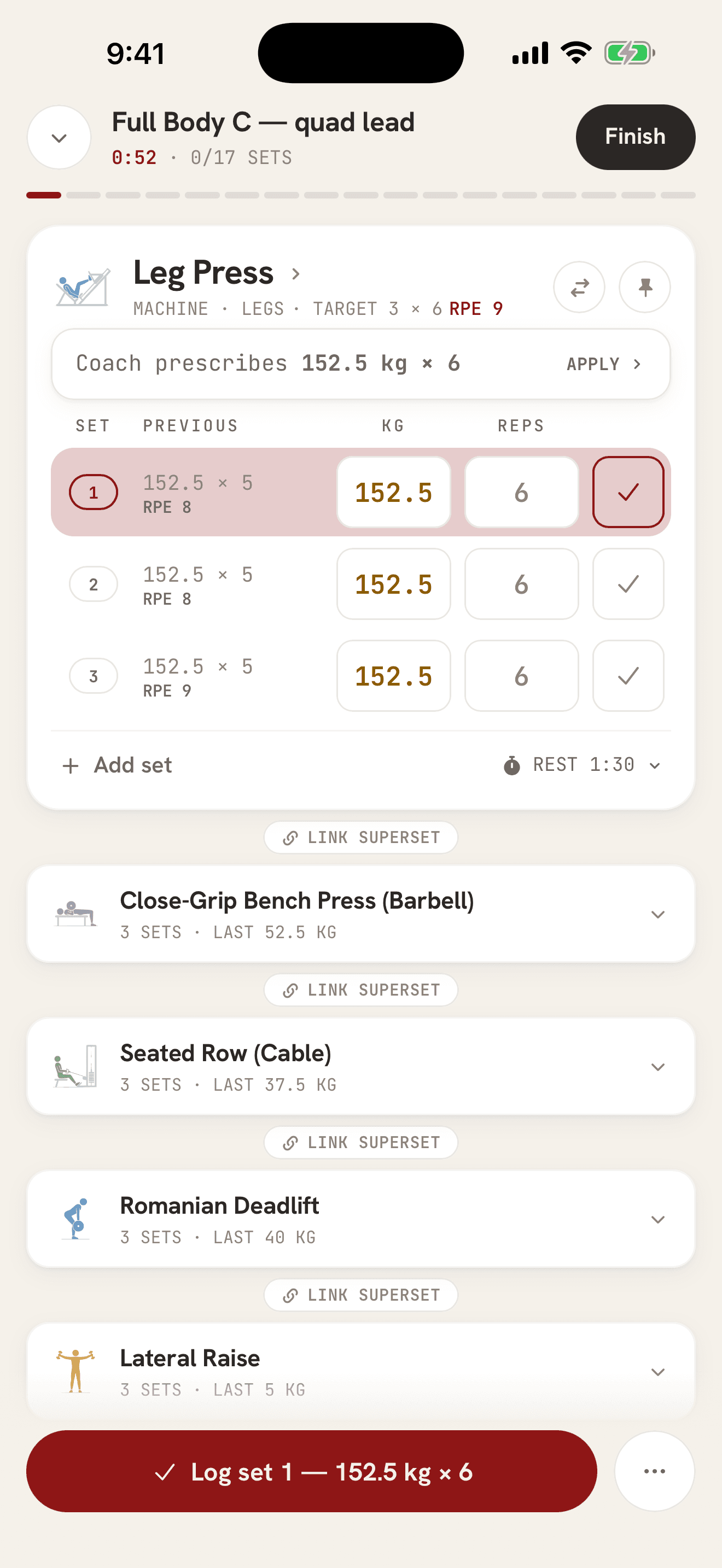
The prescribed load is already in the boxes. Log the set, rate the effort, and the next session moves.
When life gets in the way
Miss a stretch and you can refresh the rest of your program. Coach re-plans the weeks still ahead, once per program, from halfway through or straight from the check-in. Your finish date never moves.
Sessions running long can be shortened: tell Coach a session is too long and it takes sets out of the rest of the block, showing which ones go before you agree. A single session can be moved to another day, deferred to tomorrow, or skipped from its own sheet. The schedule can be realigned to new days, and a program can be abandoned in one tap.
If your subscription ends, your program, your calendar and your history stay, and you can still read every chart and record. You cannot start a workout or a new program until you subscribe again.
A session’s own sheet
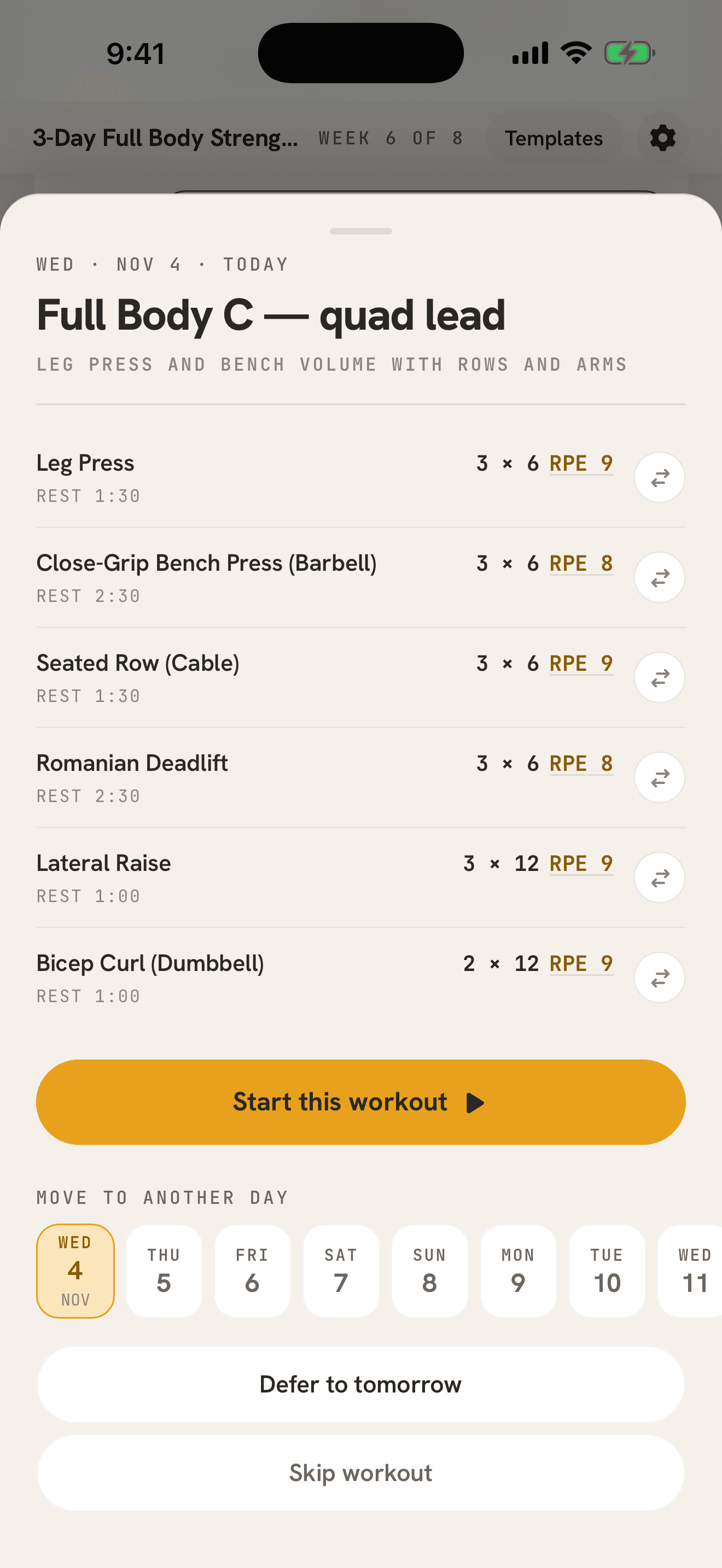
Every session opens on its own sheet: start it, move it to another day, defer it, or skip it.
Price and limits
Shojin has one subscription, and Shojin Coach is part of it. New subscribers get one month free, then A$4.99 a month or A$34.99 a year, billed by the App Store in your local currency. That is the founding price, half the regular price, and it stays yours while you stay subscribed. Cancel any time in Settings. Restore a purchase from Profile.
Coach writes up to three programs in any 30 days, and one during the free month. The subscription is bought in the iPhone app; your account and your program are the same on the web.
Not ready for Coach? A four-week Fundamentals program is built in, at two, three or four days a week. Or put your own saved templates on a weekly schedule in the Program tab.
Fair questions
What does Shojin Coach do?
It writes a training block from your answers and your lifting history, and moves your reps and loads after each session you log. You choose how long the block runs, four, six, eight or twelve weeks, or leave that to Coach as well. It checks in after your first week, and you can refresh the weeks ahead when life gets in the way. Up to three programs in any 30 days, and one during the free month.
Does Coach replace a human coach?
No. AI reads your logged lifts and picks the exercises and sets, and the loads, reps and effort follow rules that come from the published research and from experienced lifters. Then it adjusts the program as you log. It does not give injury or rehab advice, and it is not a medical device.
Do I need to log RPE?
No, but it helps. Without it your reps decide: hit the target on every set and it goes up a rep, and reach the top of the range and the load goes up. A logged RPE adds a step down for a set that was far harder than planned, and lets Coach offer a new load in the rest gap.
Can I subscribe on the web?
Not yet. Subscriptions are bought in the iPhone app through the App Store. Your account, your program and your history are the same on the web.
What does Shojin cost?
Shojin has one auto-renewing subscription, with Shojin Coach and every feature in it. New subscribers get one month free, then A$4.99 a month or A$34.99 a year at the founding price, billed by the App Store in your local currency. Cancel any time in Settings.