Jump to a section
Progressive overload means doing a little more over time: more weight, or more reps at the same weight. The American College of Sports Medicine (ACSM) describes it as fundamental to how resistance training is planned. Its 2026 position stand adds a useful detail. You can benefit from training without progression, but continued long-term progress probably needs a stimulus that keeps rising. The stand concludes that healthy adults should train progressively.
The steps are small. On a 100 kg squat, one 2.5 kg step is 2.5%. One more rep on a set of eight is a gain of about the same size. You cannot feel a change that small, and you will not remember last week's third set exactly. So the comparison that progressive overload needs cannot happen in your head.
Progressive overload is a comparison, and you can only compare with a number you wrote down.
This guide shows what to log, how the log picks your next weight, and what progress looks like over weeks. The screenshots come from the Shojin app and its demo account.
Log four things for every set
For every working set, log four things:
- The exercise. Use the same name each time, so the history of one lift stays in one place.
- The weight.
- The reps.
- The effort. Use RPE (rate of perceived exertion), where 10 means you had no rep left, or reps in reserve.
Log warm-up sets as warm-ups. A warm-up says little about your limit, so it must not count toward progress.
Effort is the easiest number to skip, and the hardest one to judge. In a meta-analysis of 12 studies, people under-predicted how many reps they had left by about one rep on average. A set of 5 at 100 kg at RPE 7 and the same set at RPE 10 are different results. Only the log shows which one you did. Our guide to RPE and RIR explains how to rate a set.
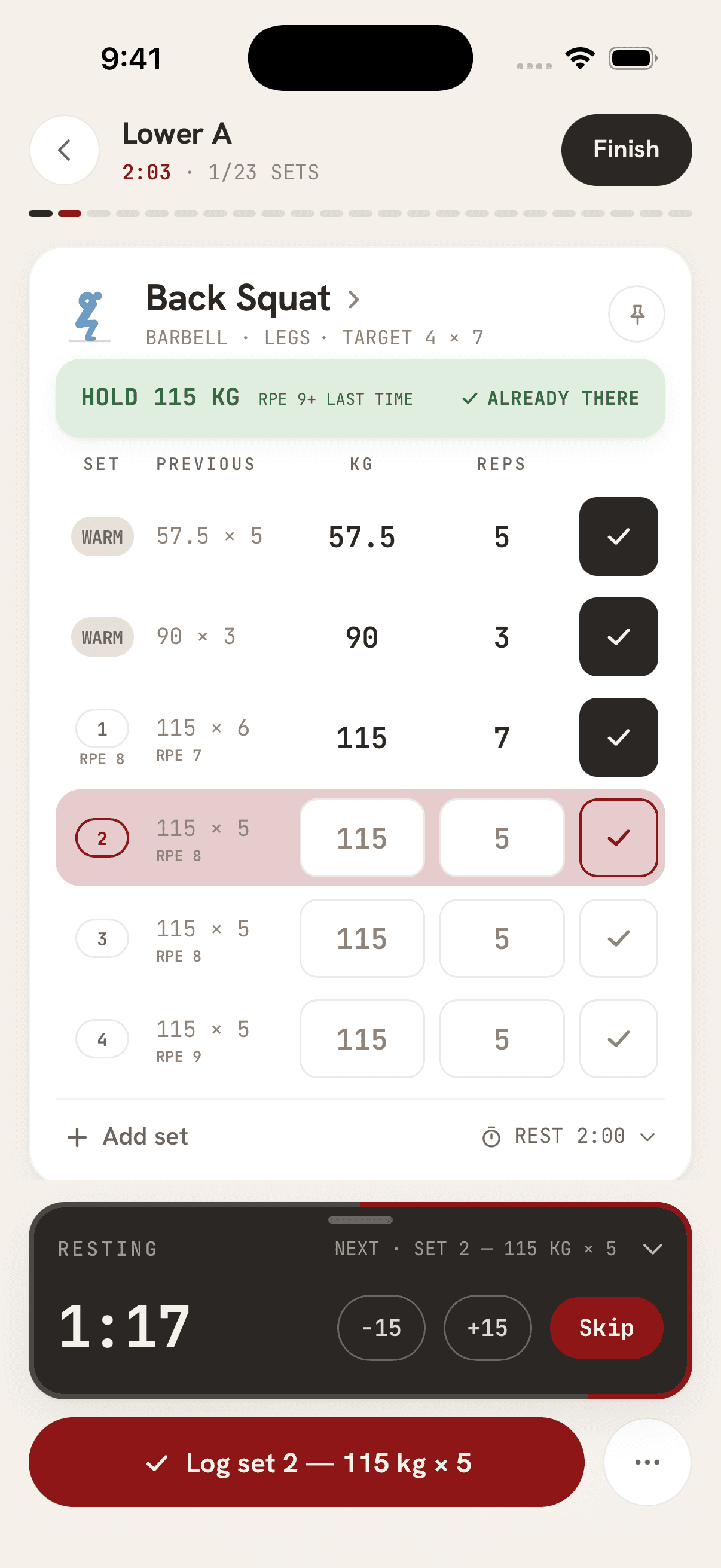
Last session's sets sit beside today's boxes.
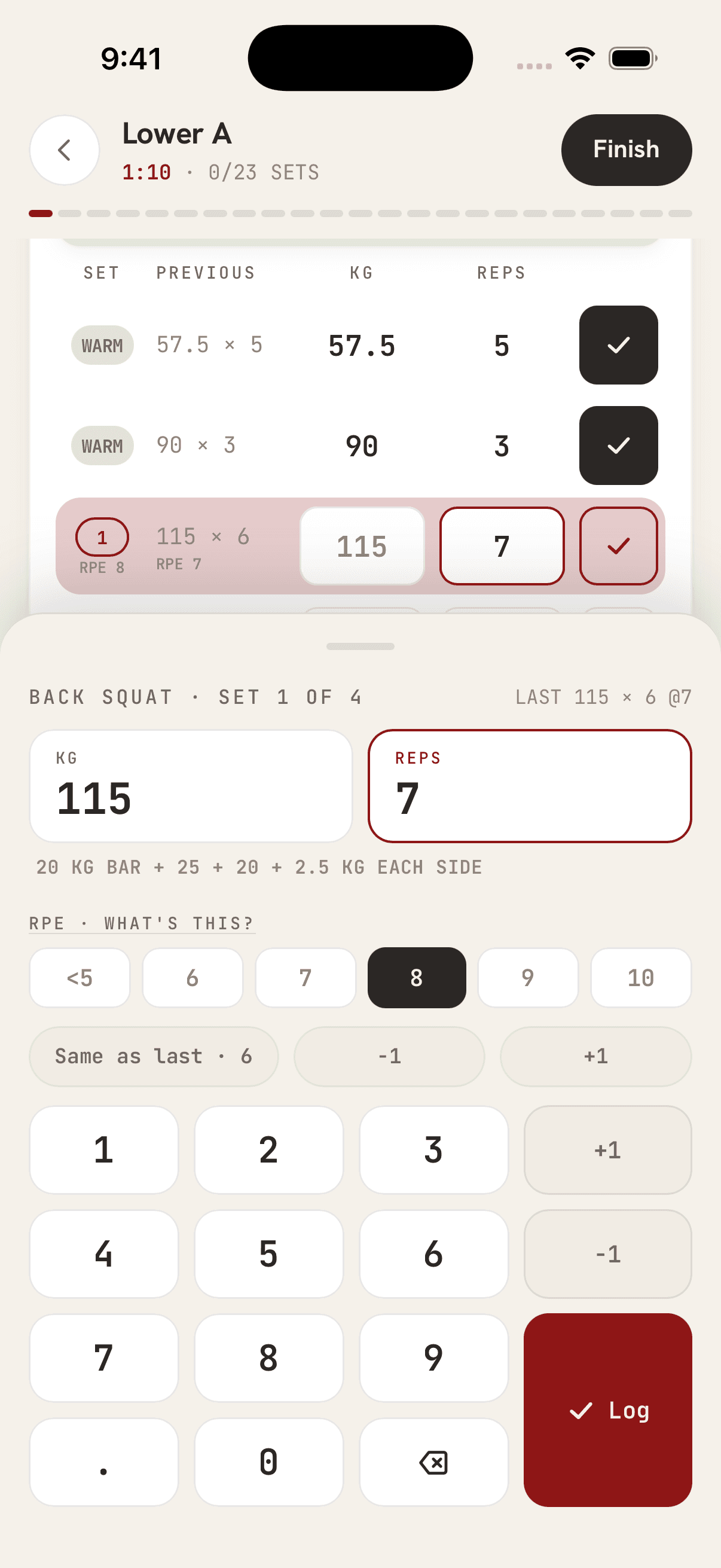
Last time's set stays in view while you log this one.
This is how Shojin brings last session into today. The Previous column shows what you lifted in each set last time, and today's boxes start from those numbers. To progress, beat one of them. Above, set 1 was 115 kg × 6 last time. Today it is 115 kg × 7: one more rep at the same weight. The row above the sets is Shojin's suggestion for the lift. Here it says to hold 115 kg, and the boxes already match it. When the suggestion is a change, the row has an Apply button that puts the new numbers in today's sets.
The short answer — Log the exercise, weight, reps and effort of every working set. Before each set, look at the same set last time and try to beat one number.
Let the log pick your next weight
Every rule for adding weight compares two or more sessions. So every rule needs a log.
The best-known rule came from the ACSM's 2009 position stand. It said to add 2 to 10% to the load when you can do one or two reps more than your target. You had to do this on two training sessions in a row. In 2026 the ACSM replaced that stand, and the new one does not repeat the 2 to 10% rule. But the shape of the rule is still useful: it needs last week's numbers and the week before's.
Double progression is a common rule. You add reps at one weight until every set reaches the top of your rep range, then you add weight and start again. Our guide to double progression has a worked example.
An effort rule reads how hard last session was. Shojin uses one. It finds the hardest set at last session's top weight. If that set was RPE 8 or easier, Shojin suggests one step more weight. If it was RPE 9 or 10, Shojin suggests the same weight. If it was RPE 9 or 10 and you did fewer reps than the session before at the same weight, Shojin suggests about 5% less. If you did not log RPE, your reps decide, and the default is to hold.
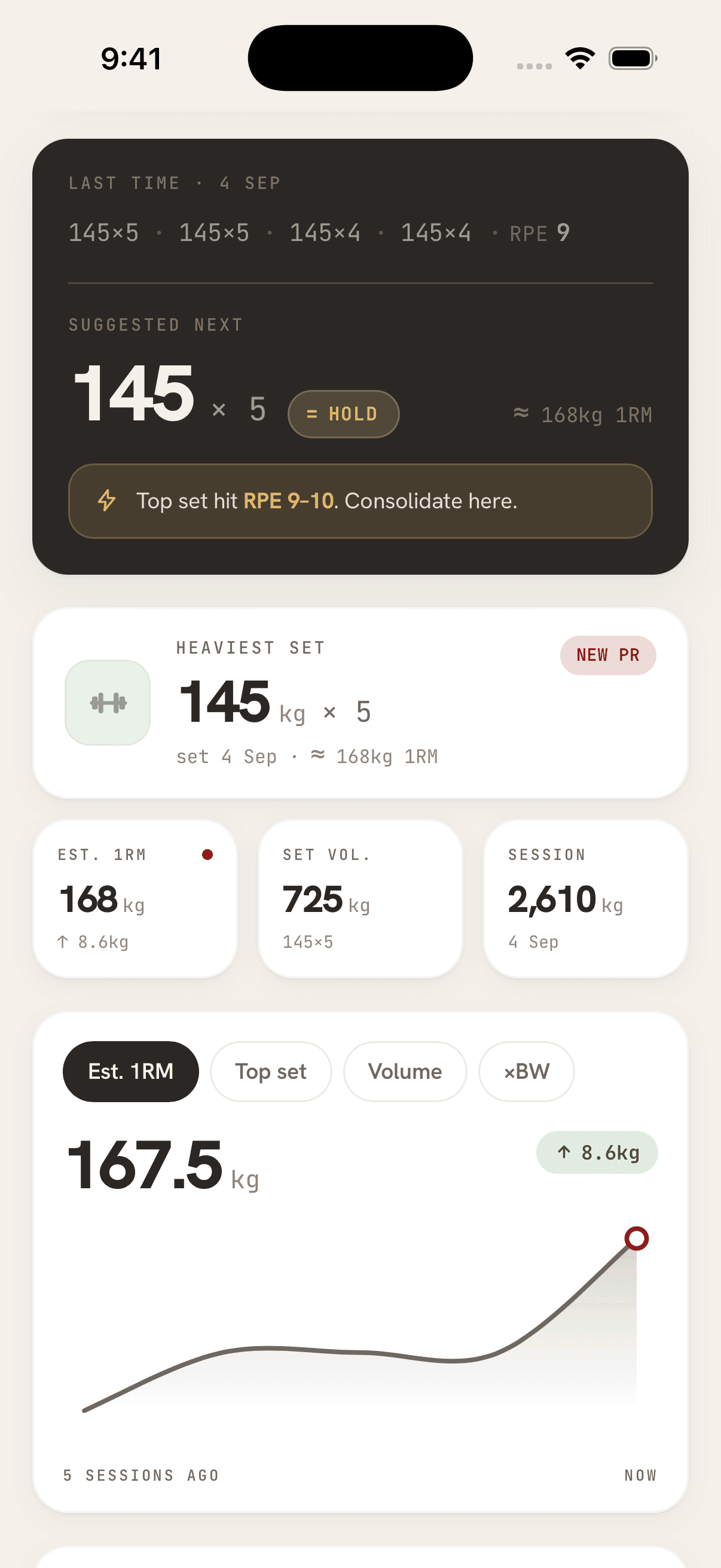
Last session sets the next target. Here the top set reached RPE 9, so the weight holds.
A hold is not a failure. It tells you to get your reps at this weight before you add more. Both routes to progress work. In an eight-week trial in trained adults, one group added weight and the other group added reps at the same weight. Both groups got stronger and both grew, and the differences between the groups were small.
Read the trend, not one session
Your strength changes from day to day. Sleep, food and stress can all change one session. Even a careful 1RM test gives a different number on a different day. In a review of 32 studies, people repeated the test 1 to 10 days apart. The typical variation between the two tests was about 4%. On a 100 kg squat, that is about 4 kg, which is more than one 2.5 kg step. So a single session up or down tells you little. A line across many sessions tells you much more.
To draw one line, every set needs one scale. 100 kg × 5 and 105 kg × 3 are both good sessions, but you cannot plot them as they are. An estimated one-rep max (e1RM) turns any set into one number: the weight that you could probably lift once. Shojin averages three published formulas (Epley, Brzycki and Lombardi) and plots that average. On that scale, the two sessions come out almost equal, at about 115 kg.
The estimate is best with low reps. In a study of 220 men, some formulas over-estimated the true 1RM and some under-estimated it. The authors noted that the average of two formulas may reduce the error. Shojin's average of three uses the same idea. Other studies found the formulas more accurate with about 10 reps or fewer. Treat an e1RM from a set of more than 10 reps as a rough guide only.
In the Deadlift chart above, the top weight went from 137.5 kg to 145 kg over five sessions. The e1RM rose by 8.6 kg, from about 159 kg to about 168 kg. From one session to the next, the weight often did not move at all. On the chart, the five sessions show a clear rise.
Find the records you would miss
A log also finds records that you would not notice. Your best weight for 5 reps can go up while your best single stays the same. Shojin keeps, for every lift, the best weight at each rep count, the heaviest set and the best e1RM, from your whole history. It marks a new record when you set it.
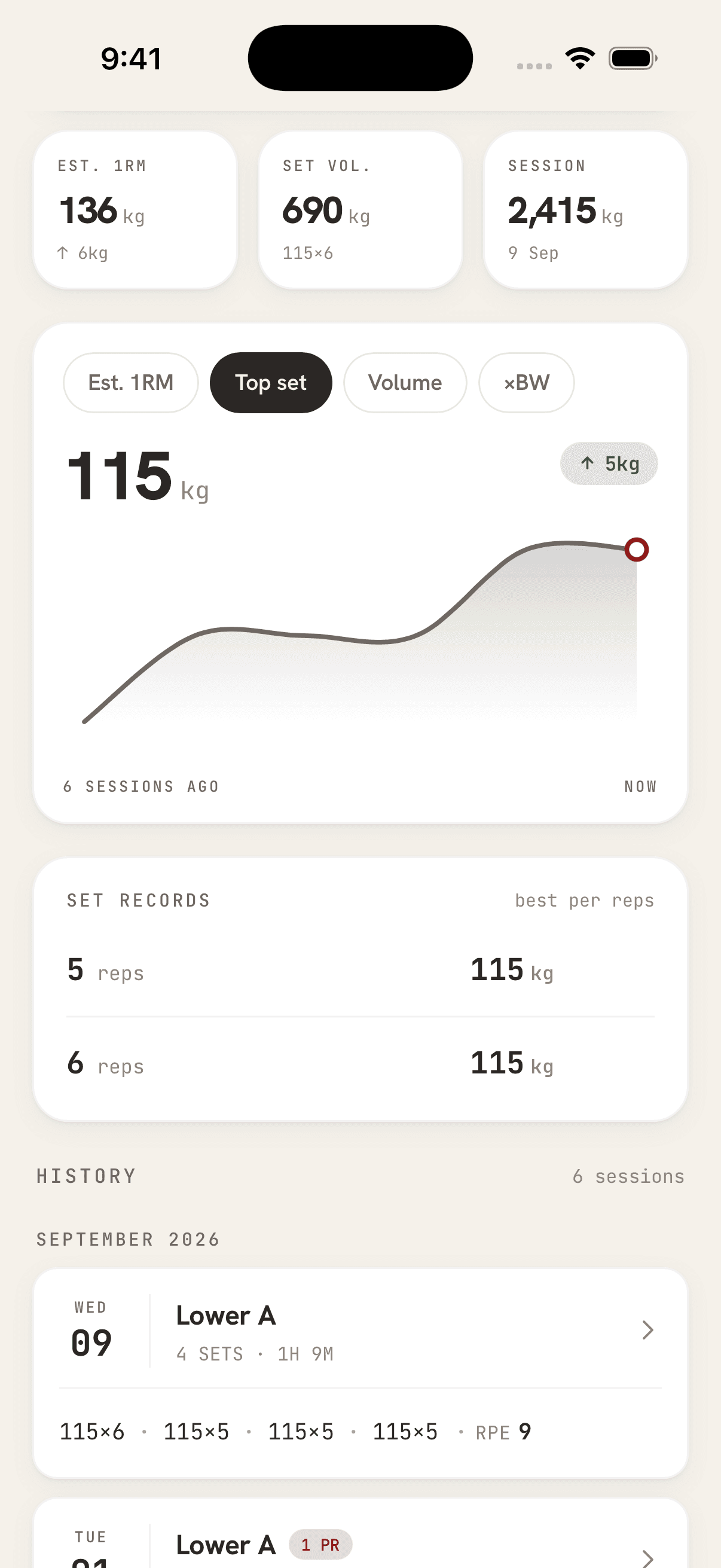
Each lift keeps its trend and its best weight at each rep count.
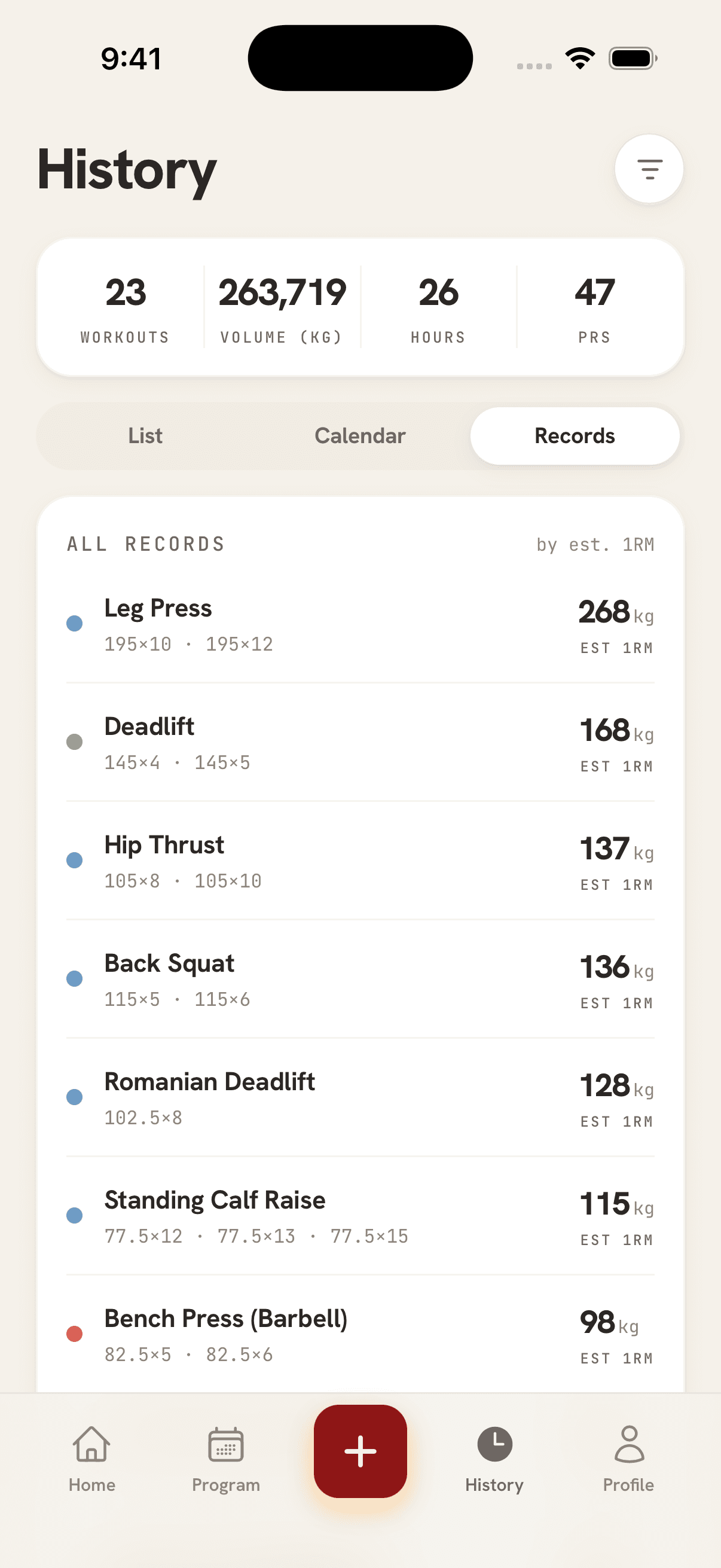
The best of every lift, ranked by estimated 1RM.
Seeing your progress may also help you reach your goals. In a meta-analysis of 138 experiments, people who monitored their progress toward a goal reached the goal more often. The effect was larger when they wrote the progress down. None of those experiments was about lifting, so treat this as a sign, not as proof. Our guide on why logging works has the detail.
Progress gets slower, so the log matters more
Beginners gain strength fast, and the gains slow down with experience. A 2004 review summed up the research. Over periods of 4 weeks to 2 years, strength rose by about:
- 40% in untrained people
- 20% in moderately trained people
- 16% in trained people
- 10% in advanced lifters
- 2% in elite lifters
The studies behind those figures used different programs and tests, so treat the numbers as rough. A meta-analysis of 140 studies shows the same direction. Trained people needed four sets to gain as much strength as untrained people gained from one set.
As the gains get smaller, a month of progress can be one rep, or one 2.5 kg step. By feel, that is nothing. In a log, it is a new record and a higher point on the line.
Know when to stop adding weight
The same log shows when a lift stops moving. One flat session is noise. A stall is fewer reps at the same weight, at the same or higher effort, over two or three sessions. Our guide to why a lift stalls covers what to change.
Shojin marks a lift when two sessions in a row reached RPE 9 or 10 at the top weight, or lost reps. It shows the next step beside the lift: hold the weight, or back off. It never compares two sessions that are more than 30 days apart, because a gap that long is a break, not a stall.
What to log, in short
- Log every working set: the exercise, the weight and the reps.
- Rate the effort of each set, as RPE or reps in reserve.
- Mark warm-ups as warm-ups.
- Before each set, look at the same set last time and try to beat one number.
- Add weight when the log shows that you are ready, not on a fixed date.
- Judge progress by the trend over weeks, not by one session.
Honest limits
Nobody has run the trial that matters most here: lifters assigned at random to log or not to log, with their strength measured after. A 2025 review found 32 randomised trials of mobile health (mHealth) programs that prescribed resistance training. Only two of them measured changes in how much people did resistance training. So the case for logging rests on how progression rules work, on goal-monitoring research outside the gym, and on what lifters get wrong about their own effort. The e1RM is an estimate, not a test. Shojin's thresholds, RPE 8 to add weight and about 5% to back off, are working conventions, not values that a trial has tested.
Start Shojin Coach free for 14 days
Logging in Shojin is free, with no cap on sets. Shojin Coach writes your program from your own lifts and adjusts it after every session you log.
New subscribers get 14 days free, then A$69.99 a year or A$9.99 a month, billed by the App Store in your local currency. Coach renews until you cancel. Cancel any time in Settings. You buy Coach in the iPhone app. If Coach ends, you keep your program, but it stops adjusting.
Common questions
How do I track progressive overload?
Log the exercise, weight, reps and effort of every working set. Before each set, look at the same set last time and try to beat one number: one more rep, or one step more weight. Add weight when the log shows that you are ready, for example when every set reached the top of your rep range.
Should I track my estimated 1RM or the weights I lift?
Both. Log the real weights and reps, because those are what you repeat next time. Use the estimated 1RM to compare sessions with different reps on one line. Treat an estimate from a high-rep set as rough.
How often should I add weight?
When your log says that you are ready, not on a fixed date. Beginners gain fast and can often add weight every week or two. Trained lifters add weight much less often, and a month of progress can be one rep.
What counts as progress if the weight stayed the same?
More reps at the same weight is progress. So are the same reps at a lower effort. In a trial in trained adults, adding reps at one weight worked about as well as adding weight.
Why did my lift go down this week?
One session tells you little, because strength changes from day to day with sleep, food and stress. Look at the trend over several sessions. If the same weight gives fewer reps at the same or higher effort across two or three sessions, treat it as a stall.
These are the same answers the page’s FAQ structured data publishes: visible text, no hidden-content mismatch.
Sources
Every number in this article traces to one of these. Where the evidence is contested or thin, the article says so rather than picking a side.
- 01
Currier BS, D'Souza AC, Singh MAF, et al. (2026). American College of Sports Medicine Position Stand. Resistance Training Prescription for Muscle Function, Hypertrophy, and Physical Performance in Healthy Adults: An Overview of Reviews. Medicine & Science in Sports & Exercise 58(4):851–872
- 02
American College of Sports Medicine (2009). Progression models in resistance training for healthy adults. Medicine & Science in Sports & Exercise 41(3):687–708
- 03
Halperin I, Malleron T, Har-Nir I, et al. (2022). Accuracy in predicting repetitions to task failure in resistance exercise: a scoping review and exploratory meta-analysis. Sports Medicine 52(2):377–390
- 04
Zourdos MC, Klemp A, Dolan C, et al. (2016). Novel resistance training-specific rating of perceived exertion scale measuring repetitions in reserve. Journal of Strength and Conditioning Research 30(1):267–275
- 05
Plotkin D, Coleman M, Van Every D, et al. (2022). Progressive overload without progressing load? The effects of load or repetition progression on muscular adaptations. PeerJ 10:e14142
- 06
Harkin B, Webb TL, Chang BPI, et al. (2016). Does monitoring goal progress promote goal attainment? A meta-analysis of the experimental evidence. Psychological Bulletin 142(2):198–229
- 07
Cox ER, Beacroft S, Jansson AK, et al. (2025). Effects of mHealth interventions to prescribe resistance training: a systematic review and meta-analysis of randomized controlled trials. International Journal of Behavioral Nutrition and Physical Activity 23(1):7
- 08
Grgic J, Lazinica B, Schoenfeld BJ, Pedisic Z (2020). Test–retest reliability of the one-repetition maximum (1RM) strength assessment: a systematic review. Sports Medicine – Open 6(1):31
- 09
Mayhew JL, Prinster JL, Ware JS, et al. (1995). Muscular endurance repetitions to predict bench press strength in men of different training levels. Journal of Sports Medicine and Physical Fitness 35(2):108–113
- 10
Mayhew JL, Johnson BD, LaMonte MJ, et al. (2008). Accuracy of prediction equations for determining one repetition maximum bench press in women before and after resistance training. Journal of Strength and Conditioning Research 22(5):1570–1577
- 11
García-Ramos A, Janicijevic D, Jukic I (2021). Concentric-only versus touch-and-go bench press one-repetition maximum in men and women. Sports Health 13(4):373–379
- 12
Reynolds JM, Gordon TJ, Robergs RA (2006). Prediction of one repetition maximum strength from multiple repetition maximum testing and anthropometry. Journal of Strength and Conditioning Research 20(3):584–592
- 13
Kraemer WJ, Ratamess NA (2004). Fundamentals of resistance training: progression and exercise prescription. Medicine & Science in Sports & Exercise 36(4):674–688
- 14
Rhea MR, Alvar BA, Burkett LN, Ball SD (2003). A meta-analysis to determine the dose response for strength development. Medicine & Science in Sports & Exercise 35(3):456–464