Jump to a section
Most workout app comparisons list features. The more useful question is what you want the app to do. Some apps record the program you bring. Others write the program for you and change it as you train. This guide compares five apps on the things that decide that: what is free, how you log effort, whether the plan adapts, and what it costs.
We make Shojin, so read this as our view.
Every fact about the other apps comes from their own websites, help pages and App Store listings, checked on 30 September 2026 and linked in the sources below. Prices are from the Australian App Store. Apps change often, so check before you buy.
What to look for
- What the free version really does. Some apps are free to log but cap your routines. Others need a subscription after a trial.
- How you log effort. A rating on every set, such as RPE (how hard the set felt, where 10 means no rep was left), tells an app far more than one rating per workout.
- Whether the plan moves. A plan that reads your sets and changes the next session saves you the maths.
- Where it runs. Check your phone, your watch and the apps you already use.
Strong
Verdict: the cleanest logbook, for lifters who bring their own program.
What it does well. Strong's pitch is "Think less. Lift more.", and the app lives up to it. Logging is fast, with RPE on every set and warm-up, drop and failure sets. Its Apple Watch app can log a workout without your iPhone. It runs on iPhone and Android, syncs with Apple Health, and shows no ads. A rest timer on the Lock Screen arrived in August 2026.
Where it falls short. The free version saves unlimited workouts but only three custom routines. The plate calculator and warm-up calculator are in the paid tier, Strong PRO, which is A$7.49 a month on the Australian App Store, with yearly and lifetime options. Strong says it is built for a program you run yourself, such as StrongLifts 5×5. It does not advertise a program that writes itself or adapts.
Compared with Shojin. Both are fast loggers with RPE on every set. Shojin puts the plate maths on the keypad for free, and Shojin Coach writes and adjusts the program for you. Strong has the Watch app and Apple Health, and Shojin has neither.
Fitbod
Verdict: the best-known AI workout app, but it plans one session at a time and has no free tier.
What it does well. Fitbod builds each workout from your goal, experience, equipment and training split, and from a recovery score of 0 to 100% for each muscle group. You can set up more than one gym, each with its own equipment and weight steps. Its library has more than 1,000 exercises with video demos. It runs on iPhone, Android, Apple Watch and Wear OS, and connects to Apple Health, Health Connect and Strava.
Where it falls short. New users get a 7-day trial. After it, logging new workouts needs a subscription, from A$19.99 a month on the Australian App Store. Fitbod works session by session, and its help centre says it "doesn't have a built-in weekly planner yet", so you cannot see the weeks ahead. You rate effort once per exercise, as reps in reserve, from your hardest or last set. There is no iPad app.
Compared with Shojin. Fitbod has the bigger library, the watch apps and the integrations. Shojin's logger is free, you rate effort on every set, and Shojin Coach writes the whole block on your calendar for about half Fitbod's monthly price.
JEFIT
Verdict: the biggest feature list and a 12-week AI plan, but effort is logged once per session.
What it does well. JEFIT says it has more than 1,400 exercises, hundreds of its own plans and thousands more from its community. It has a social feed, groups and contests. It runs on iPhone, Android, Apple Watch, Wear OS and the web, and syncs with Apple Health and Strava. Its paid tier, Elite, adds an Adaptive Plan: a 12-week AI plan in three four-week blocks, built from your goal, level and equipment. With its periodisation switched on, weight targets are rounded to the plates and dumbbells you own.
Where it falls short. JEFIT's own comparison page says it logs RPE "at the session level, not per individual set", and that "Jefit doesn't have" a plate calculator. The Adaptive Plan and full analytics are Elite only, at A$19.49 a month or A$105.99 a year on the Australian App Store. The free tier allows seven custom exercises.
Compared with Shojin. JEFIT has far more exercises, plans and devices. Shojin reads effort on every set, puts the plate maths on the keypad, and charges about half as much for Shojin Coach as JEFIT does for Elite.
Alpha Progression
Verdict: the closest to Shojin Coach in idea, at about twice the price, with no import and no social side.
What it does well. Alpha Progression's plan generator asks for your goal, experience, equipment, training days, session length and which muscles to prioritise, then writes a plan of four to seven weeks, with an optional deload. Its progression tips give a weight and reps for every set, from your previous sessions, the sets you have already done today and the weights your gym has. Its 795 exercises each have a real demonstration video, and the free version logs without limits and shows no ads. It runs on iPhone and Android and connects to Apple Health and Health Connect.
Where it falls short. The plan generator, the progression tips, effort logging (as reps in reserve), charts and the plate calculator are all in the paid tier, Pro. Pro is A$19.99 a month or A$119.99 a year on the Australian App Store, and only the yearly plan has a free trial. Alpha Progression says it "does not have an import feature", so your history from another app stays behind. It has no social feed or profiles, no web app and no watch app.
Compared with Shojin. Alpha Progression has the videos, the Android app and Apple Health. In Shojin, effort logging and the plate maths are free, you can import your history from Strong or Hevy, and Shojin Coach costs about half as much.
A notebook or a spreadsheet
Verdict: free and flexible, but you do all the maths.
A notebook costs nothing, never needs an update, and lets you log anything. What it cannot do is the arithmetic. You work out every jump, you time your own rest, and your history is hard to read back when a lift stops moving. For most lifters, a free logging app is the same price with the maths done for them.
Shojin
Verdict: a free logger, and a plan built from your own lifts that moves with every session.
What it does well. Logging in Shojin is free, with no cap on sets and no ads. RPE is one tap on every set. Tell Shojin your bar and plates once, and every weight it suggests is a jump your rack can make. Shojin's extra features, such as unlimited routines and full chart history, are free during early access.
Shojin Coach is AI-assisted and science-based. It reads your logged lifts and a short quiz on your goals and schedule, then writes a program of four to twelve weeks with real weights on every set. Its rules come from published research and from experienced lifters. After every session it reads each working set: when every set reaches the top of the rep range, the weight goes up, and when a set falls below the range or feels far too hard, the weight comes down. During a session, the rest timer offers lighter or heavier weights if a set was far off its target. We explain the method in double progression.
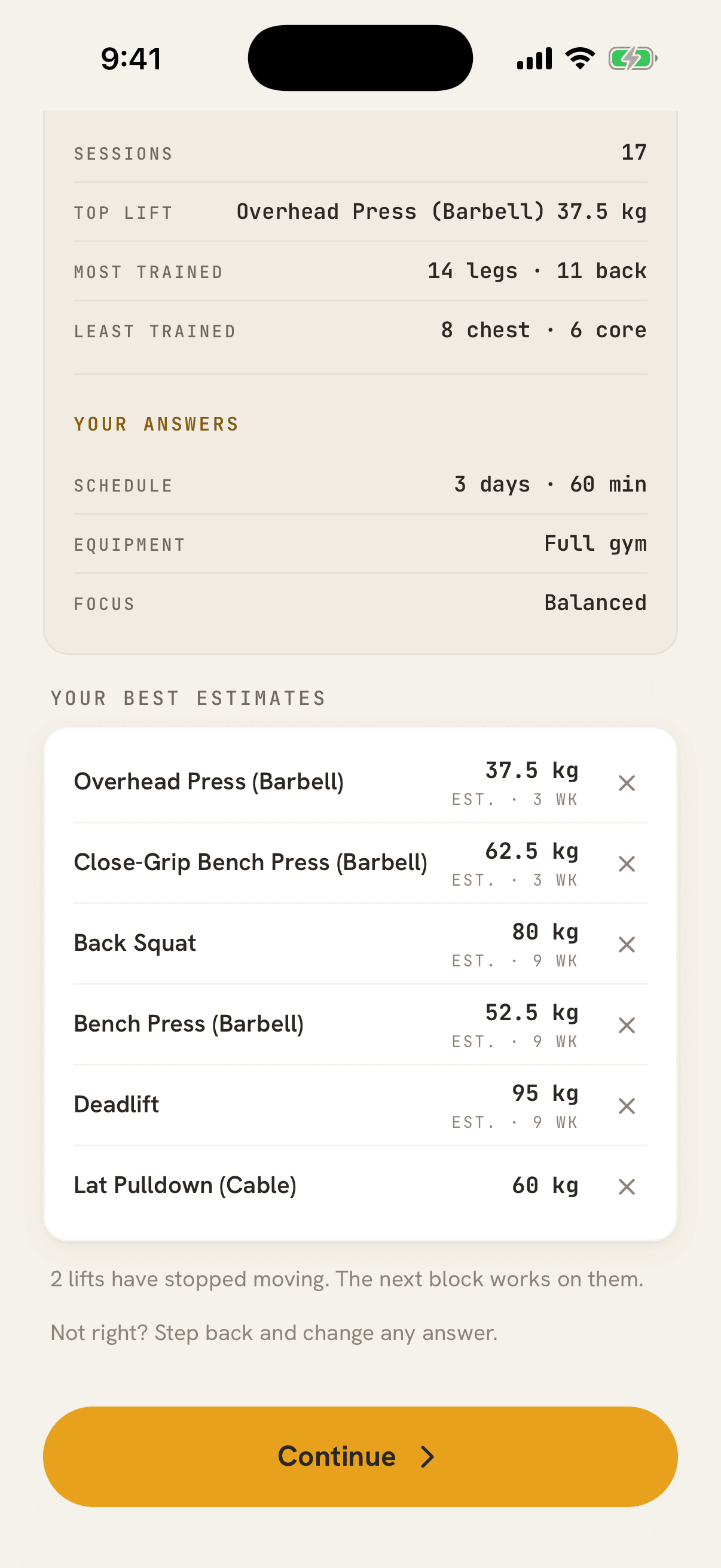
Coach shows the numbers it will use before it writes anything.
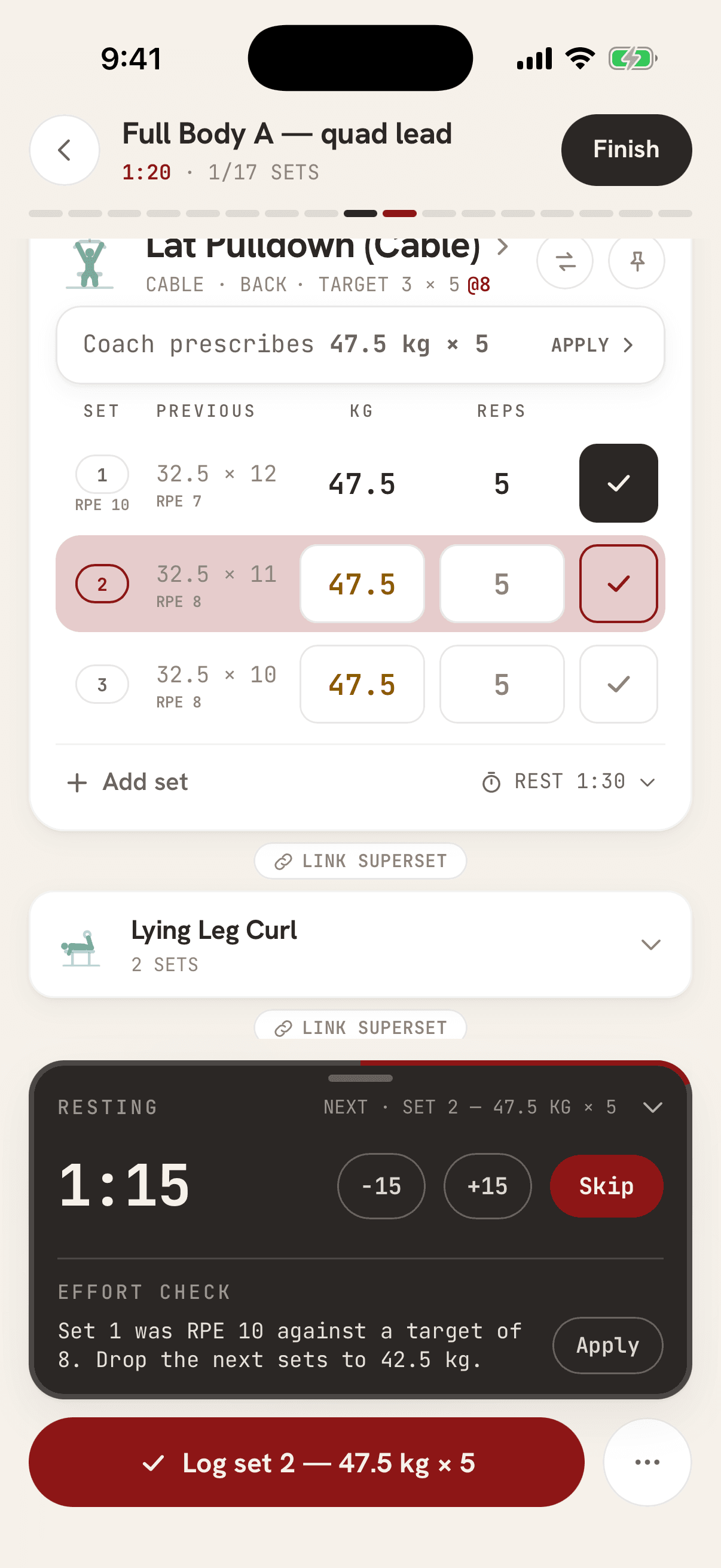
Too hard? The rest timer offers a lighter weight for the next sets.
There is more around the logging. A Training Circle is a private group of up to 12 friends who see each other's training days and send high-fives. Shojin sums up each week and month as a card you can share. On iPhone, the rest timer runs on the Lock Screen and in the Dynamic Island, and a home-screen widget shows your week. If you are moving from Strong or Hevy, Shojin imports their CSV exports.
Where it falls short. The Shojin app is iPhone only. There is no Android app yet, no Apple Watch app and no Apple Health link. New accounts start in the iPhone app, though an existing account can also log in a browser at shojin.fit. The library has 163 built-in exercises with written cues and no videos, and there is no public library of programs. A Training Circle is a small private group, not a public feed.
How to choose
- You run your own program and want a watch app: Strong.
- You want a new workout picked for you each day, and you wear a watch: Fitbod.
- You want the most exercises, plans and community: JEFIT.
- You want a generated plan with exercise videos, on Android: Alpha Progression.
- You want a free logger, and a plan built from your own lifts that adapts to every set you log: Shojin.
Start Shojin Coach free for 14 days
Logging in Shojin is free, with no cap on sets. Shojin Coach writes your program from your own lifts and adjusts it after every session you log.
New subscribers get 14 days free, then A$69.99 a year or A$9.99 a month, billed by the App Store in your local currency. Coach renews until you cancel. Cancel any time in Settings. You buy Coach in the iPhone app. If Coach ends, you keep your program, but it stops adjusting.
Common questions
What is the best free workout tracker?
Strong, JEFIT, Alpha Progression and Shojin all let you log workouts for free. Strong's free version allows three custom routines, and Alpha Progression's free version does not include effort logging. Fitbod has no free tier after its 7-day trial. Shojin's free logger has no cap on sets and includes RPE on every set.
Which workout apps write a program for you?
Fitbod builds one workout at a time. JEFIT Elite writes a 12-week Adaptive Plan. Alpha Progression Pro writes plans of four to seven weeks. Shojin Coach writes blocks of four to twelve weeks and adjusts them after every session you log. Strong records the program you bring.
Can I move my workout history to Shojin?
Yes. Shojin imports CSV exports from Strong and Hevy, and a general CSV file with exercise, date, and weight or reps columns.
Is Shojin on Android?
No. Shojin is an iPhone app today. If you already have an account, you can also log in a web browser at shojin.fit.
Does Shojin connect to Apple Health?
No. Shojin does not connect to Apple Health or Health Connect.
These are the same answers the page’s FAQ structured data publishes: visible text, no hidden-content mismatch.
Sources
Every number in this article traces to one of these. Where the evidence is contested or thin, the article says so rather than picking a side.
- 01
Strong, home page
- 02
Strong, AU App Store listing
- 03
Strong Help Centre, About RPE
- 04
Strong Help Centre, What is Strong
- 05
Strong Help Centre, Sync with Apple Health
- 06
Strong Help Centre, Plate Calculator
- 07
Strong Help Centre, Strong PRO
- 08
Fitbod Help Centre, How Fitbod creates your workout
- 09
Fitbod Help Centre, My Plan
- 10
Fitbod Help Centre, System requirements
- 11
Fitbod Help Centre, Apple Watch
- 12
Fitbod Help Centre, Strava integration
- 13
Fitbod Help Centre, How the trial works
- 14
Fitbod, AU App Store listing
- 15
Fitbod Help Centre, Save a workout
- 16
Fitbod Help Centre, How does Fitbod adapt
- 17
Fitbod Help Centre, Reps in Reserve
- 18
Fitbod, home page
- 19
Fitbod blog, Family Plan
- 20
JEFIT, Elite page
- 21
JEFIT blog, Fitbod vs Strong vs JEFIT vs Hevy
- 22
JEFIT, AU App Store listing
- 23
JEFIT, Watch page
- 24
JEFIT, Support
- 25
JEFIT blog, Adaptive mesocycle training
- 26
JEFIT, US App Store listing
- 27
JEFIT blog, Periodization on your own plan
- 28
JEFIT blog, JEFIT vs Strong
- 29
Alpha Progression, complete guide
- 30
Alpha Progression, AU App Store listing
- 31
Alpha Progression, home page
- 32
Alpha Progression, fact sheet
- 33
Alpha Progression blog, Alpha Progression vs Hevy