Jump to a section
Runners love Runna for one reason. You tell it your goal, and it writes the plan. You open the app, it tells you today's session, and when training goes well or badly the plan changes. You never stare at a blank screen and wonder what to do.
Most gym apps give you the blank screen. They are logbooks: an exercise list, a timer and a place to type numbers. That works if you already have a program. It does not answer the question most lifters walk in with: what should I lift today, and how heavy?
Shojin Coach answers it. It is the Runna idea, built for the barbell.
Same idea, built for lifting
It starts from your goal. Runna starts from a race and a date. Coach starts from what you want in the gym: build muscle, get stronger, both, or general fitness. You also tell it which days you train, how long you have, what equipment you have, and any area to go easy on, such as knees or lower back.
It starts from your lifts. Runna starts from how fast you run now. Coach starts from what you lift now. Before it writes anything, it shows you the numbers it will use, read from your log. For every lift you have logged in Shojin, week one's weight comes from your recent sets. For a lift you have never done, the box starts empty with a suggested starting weight, and your first session sets the number.
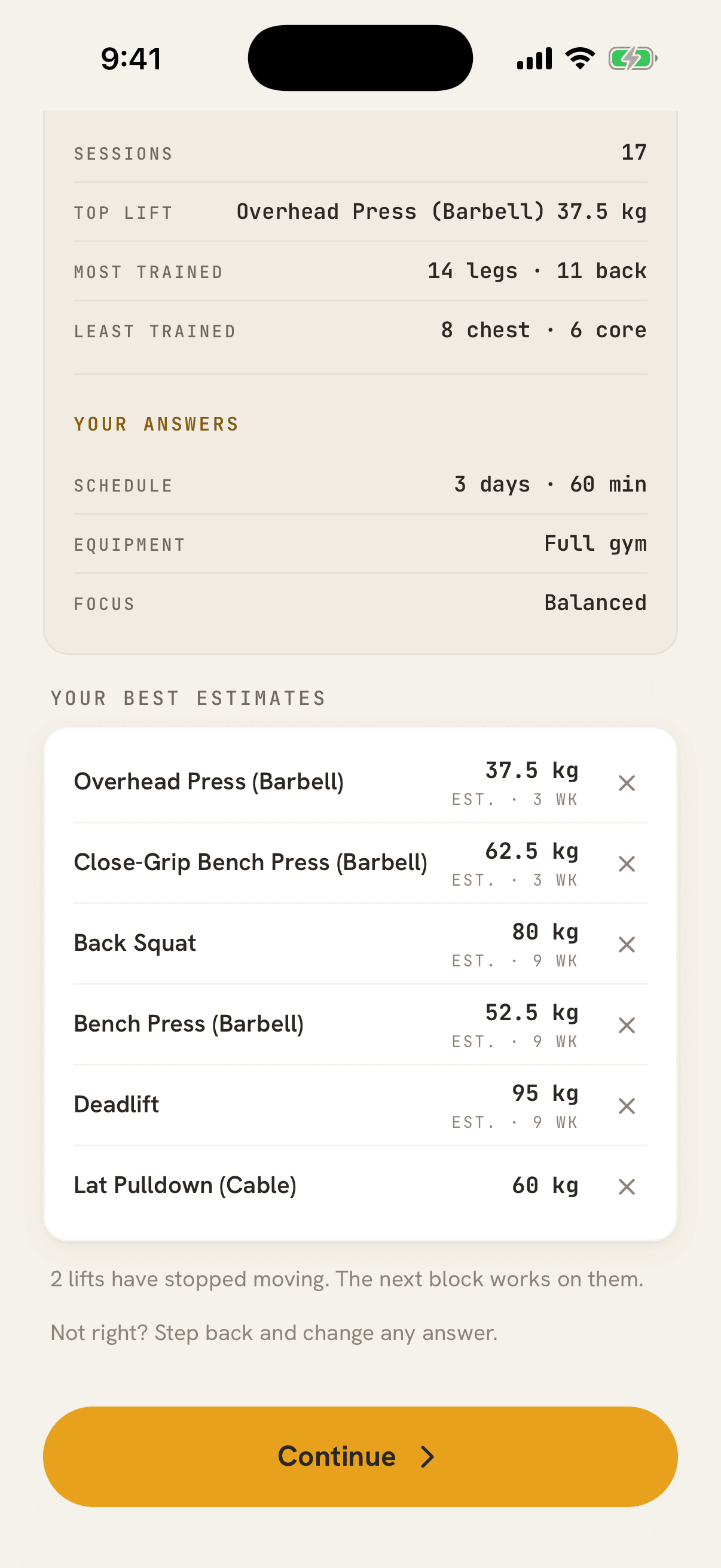
Coach shows the numbers it will use before it writes anything.
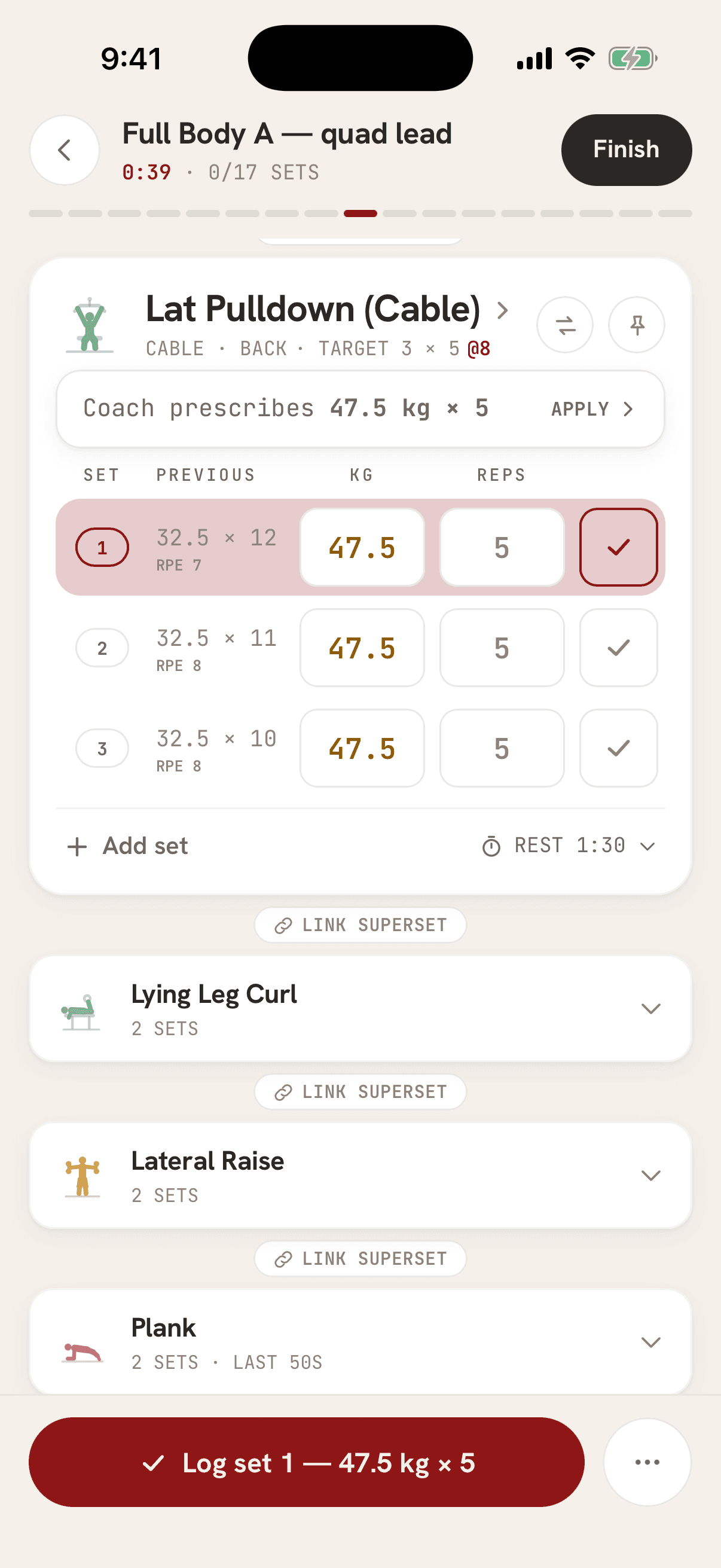
Week one arrives with real weights on every set.
It reads your effort. A running watch measures pace. A barbell measures nothing, so Coach reads the two things you log: your reps, and how hard each set felt as RPE (rate of perceived exertion, where 10 means you had no rep left). If you skip RPE, reps alone decide. It also reacts during the session: if a set feels much harder or easier than the target, the rest timer offers to change the weight of the sets you have left. We explain RPE in RPE vs RIR.
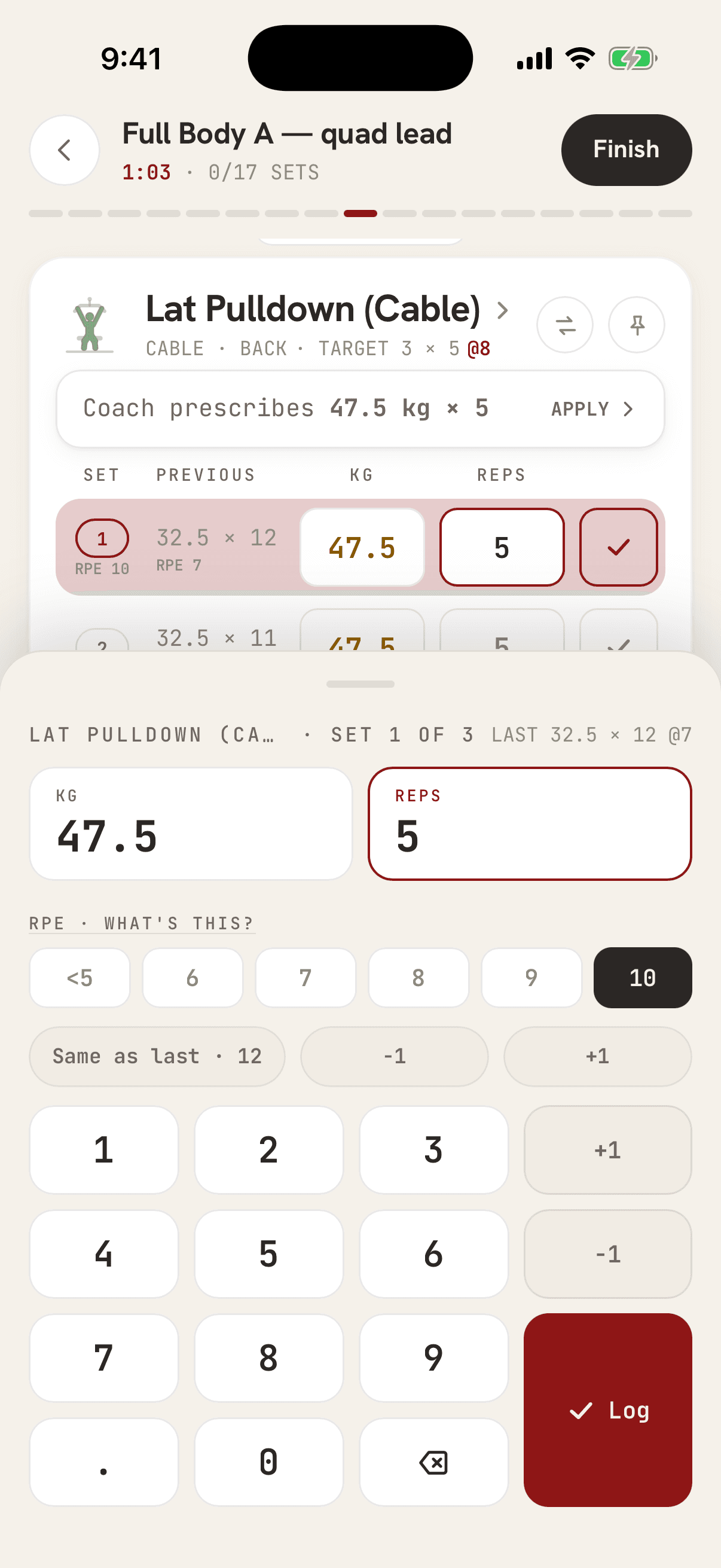
One tap rates the set.
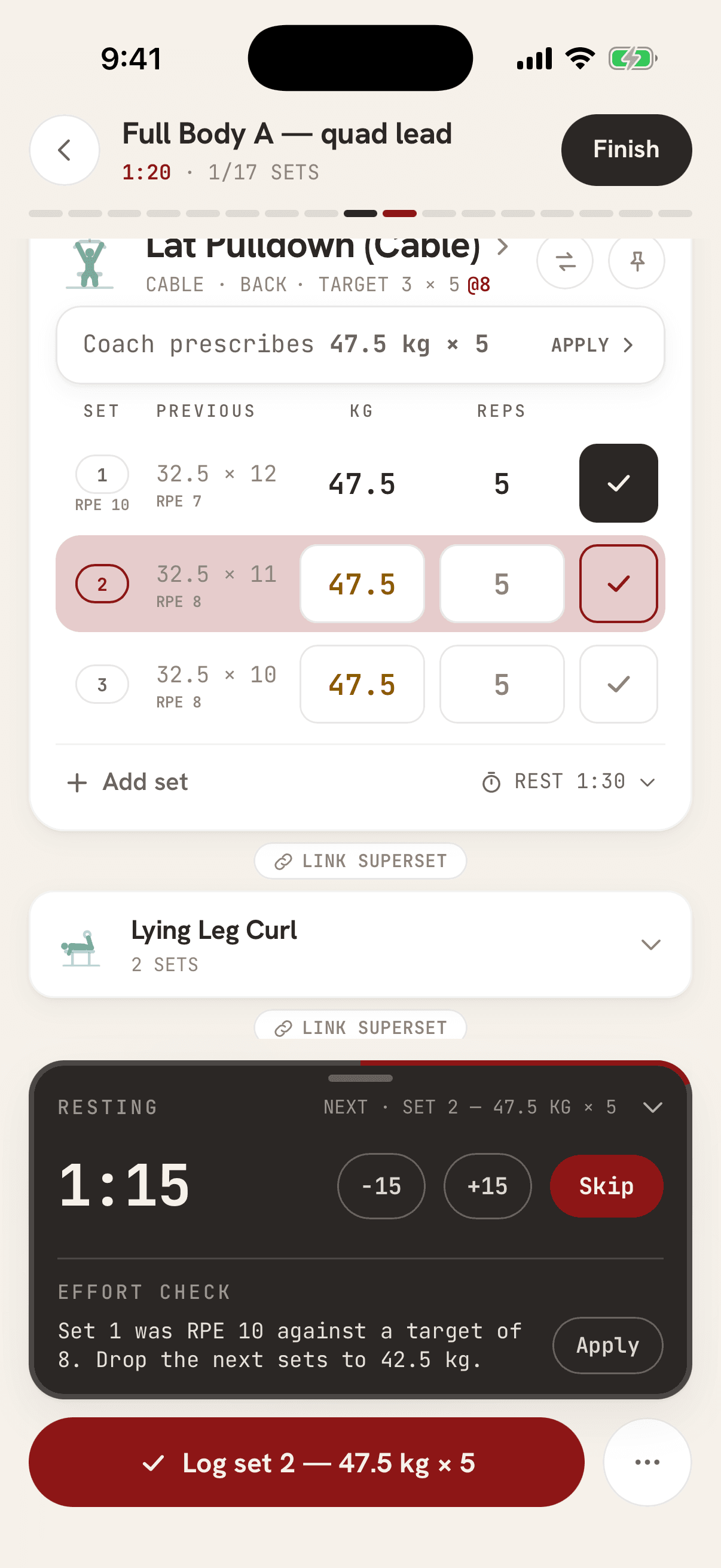
Too hard? The rest timer offers a lighter weight for the next sets.
It knows your plates. "Add 2.5%" means nothing at a rack whose smallest plates are 2.5 kg. When Coach adds weight, it adds the smallest step your plates can make.
What happens after every session
Runna adapts your runs. Coach adapts every lift on its own, because your squat and your curl do not move at the same speed. Each lift has a rep range, and after each session Coach reads every working set against it.
- Every set reached the top of the range and none was an RPE 10: the weight goes up next session.
- Every set hit today's target, but not the top: same weight, one more rep next time.
- A set fell below the range, or felt 1.5 RPE or more harder than the target: the weight comes down.
- Anything else: the plan holds.
That is the standard way to earn weight on a lift, and why a lift stalls explains why it works. The difference is that you never have to track it. Coach does, set by set. When you let Coach pick the length of the block, the last week is a lighter deload, so you finish fresh.
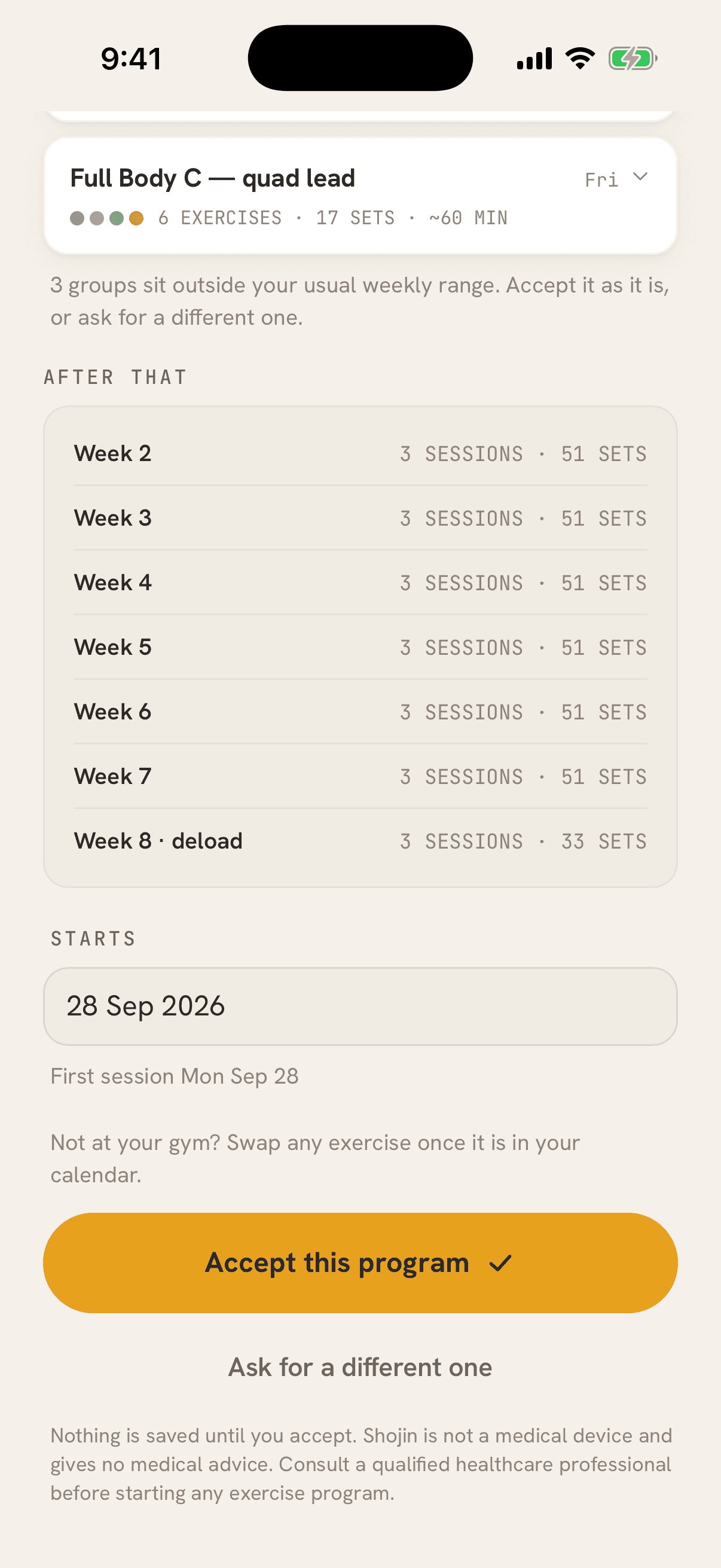
A Coach-length block ends with a lighter week.
What about Runna's own strength sessions?
Runna can add strength sessions to a running plan, and for a runner who wants two sessions a week to stay durable, they do the job. They are built to support your running, and in Runna's words they "sit outside the adaptive running plans". If the gym is your main goal, you want a plan where the lifting is the plan.
Start your plan
Logging in Shojin is free, with no cap on sets. Shojin Coach is free for 14 days, then A$9.99 a month or A$69.99 a year. You can cancel in Settings before the trial ends. If Coach ends, you keep your program, but it stops adjusting.
Common questions
Is there a Runna for weightlifting?
Shojin Coach is built on the same idea: a plan written from your goal and your current numbers, which changes after every session you log. It covers lifting only, with weights taken from your own history.
Do I have to log RPE?
No. Reps alone tell Coach whether you hit the target. RPE tells it how close you were to your limit, which makes the call better: it separates "ready for more weight" from "barely made it".
Can I use Shojin and Runna together?
Yes. They do different jobs. Runna plans your runs and Shojin Coach plans your lifting.
These are the same answers the page’s FAQ structured data publishes: visible text, no hidden-content mismatch.
Sources
Every number in this article traces to one of these. Where the evidence is contested or thin, the article says so rather than picking a side.
- 01
Runna, Features
- 02
Runna Help Centre, How to use the Plan Realignment feature
- 03
Runna Help Centre, Adding strength training to your Runna plan
- 04
Zourdos MC, Klemp A, Dolan C, et al. (2016). Novel resistance training-specific rating of perceived exertion scale measuring repetitions in reserve. Journal of Strength and Conditioning Research 30(1):267–275
- 05
American College of Sports Medicine (2009). Progression models in resistance training for healthy adults. Medicine & Science in Sports & Exercise 41(3):687–708