Jump to a section
Strong is a fast, clean logbook for the program you bring. Many lifters reach a point where they want more than a log. They want a plan that is written from their own lifts and moves as they get stronger. This guide compares Strong and Shojin on what each does well and what each costs, and shows how to bring your Strong history across if you switch.
We make Shojin, so read this as our view.
Every fact about Strong comes from its App Store listing, its website and its help centre, checked on 7 October 2026 and linked in the sources below. Prices are from the Australian App Store. Apps change often, so check before you buy.
Who this guide is for
You like how Strong logs, but you want the plan to move with you. After each session you still work out what to lift next time, and you would rather an app did that from your own numbers. Or you have reached the free version's limit of three custom routines, and you are deciding whether to pay for Strong PRO or look around.
Our workout tracker comparison adds Fitbod, JEFIT and Alpha Progression, if you want a wider view.
What Strong does well
Strong's pitch is "Think less. Lift more.", and the app lives up to it. Logging is quick. You can rate each set with RPE (how hard the set felt, where 10 means no rep was left), and tag sets as warm-up, drop or failure sets. The Apple Watch app logs a workout with or without your iPhone. Strong runs on iPhone and Android, works with Apple Health, and shows no ads. Since version 6.5.0 in August 2026, its rest timer also shows on the Lock Screen and in the Dynamic Island.
Its users rate it highly, at 4.8 stars from about 13,000 ratings on the Australian App Store.
An alternative to Strong that writes your program
Shojin logs much the way Strong does, with weight, reps and RPE on every set. Logging in Shojin is free, with no cap on sets. What changes is what happens around the log.
- A program written from your own lifts. Shojin Coach reads your logged lifts and a short quiz on your goals and schedule, then writes a program of four to twelve weeks. After every session you log, it adjusts what comes next. We explain the method in double progression.
- A suggestion for what to lift next. Each exercise shows what you lifted last time and suggests the next weight from your history.
- Plate maths on the keypad. Tell Shojin your bar and plates once. The keypad shows the plates for each side, and every barbell weight it suggests is a jump your rack can make.
- A private Training Circle. Up to 12 friends see each other's training days and send high-fives.
- Your Strong history, as often as you like. Shojin imports Strong's CSV export. Import a newer export later and Shojin skips the workouts it already has.
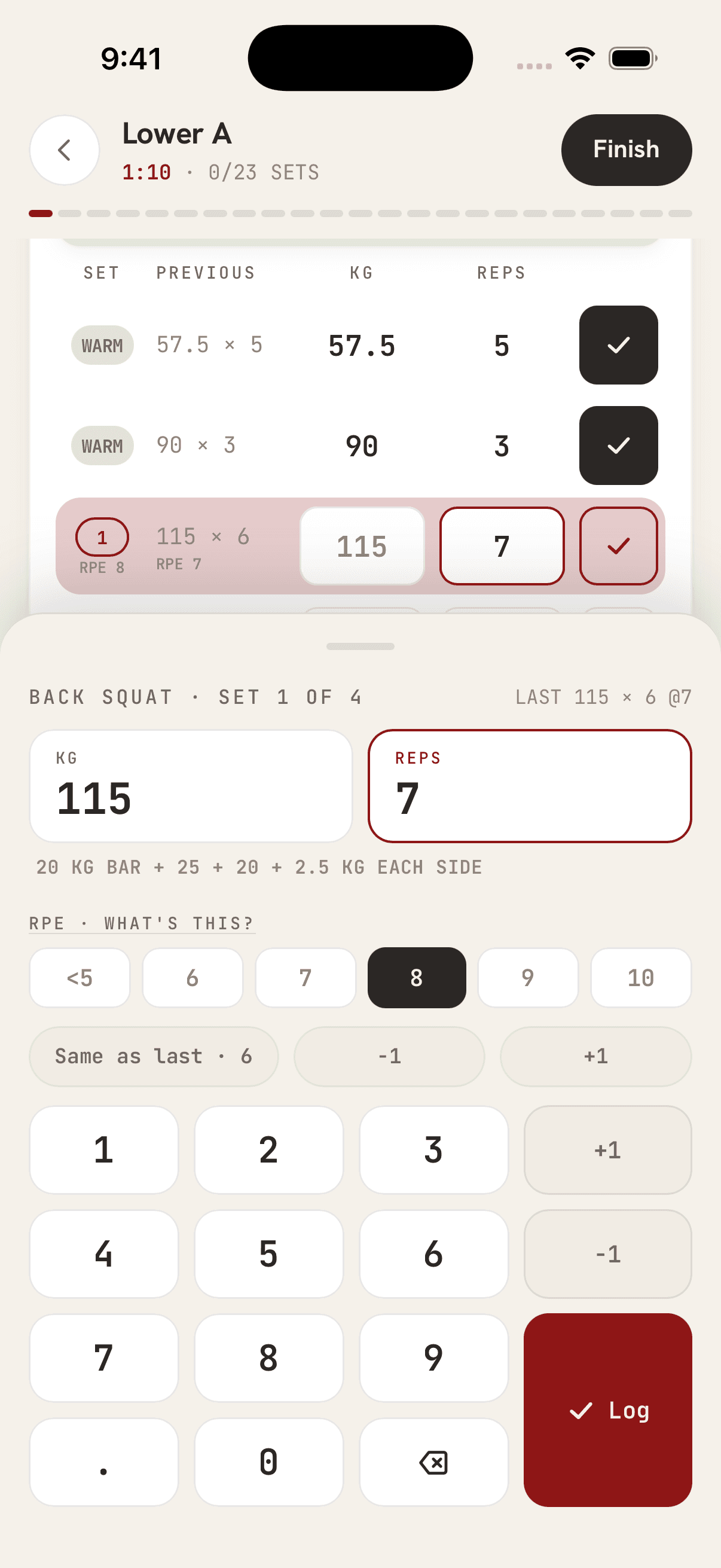
Last time's set and the plates for each side, on the keypad.
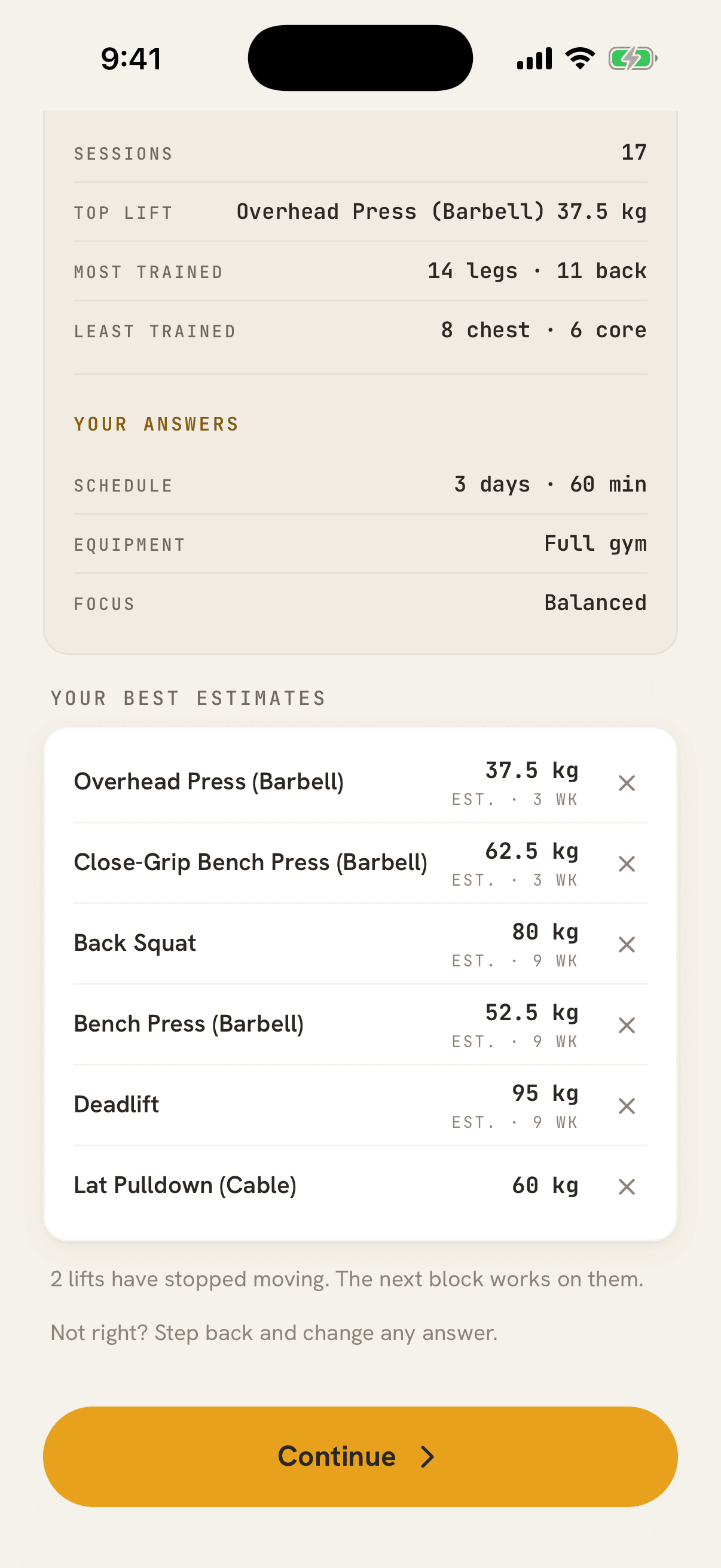
Coach shows the numbers it will use before it writes anything.
Where Strong is ahead
Strong does several things Shojin does not, and one of them may decide it for you.
- Apple Watch. Strong's Watch app logs with or without your iPhone. Shojin has no Watch app.
- Apple Health. Strong works with Apple Health. Shojin does not connect to Apple Health.
- Android. Strong runs on Android. Shojin is an iPhone app, though an existing account can also log in a browser at shojin.fit.
- Failure sets. Strong lets you tag a set as a failure set. Shojin's set types are working, warm-up and drop.
- A warm-up calculator. Strong PRO tells you which weights to warm up with. Shojin has no warm-up calculator.
- A lifetime price. Strong sells a lifetime membership, Strong PRO Forever. Shojin Coach is a subscription only.
What each app costs
Prices are from the Australian App Store, checked on 7 October 2026.
Strong. The free version saves unlimited workouts but allows three custom routines. Strong PRO lifts that limit and adds tools such as the warm-up calculator. It is A$7.49 a month or A$27.49 for six months, and the store lists yearly and lifetime options at more than one price each.
Shojin. Logging is free. During early access, Shojin's extra features, such as unlimited routines, are free as well. Shojin Coach is A$9.99 a month or A$69.99 a year after the free trial, billed by the App Store in your local currency. You buy Coach in the iPhone app.
Month for month, Strong PRO costs less than Coach. You pay for different things. Strong PRO adds tools to your logbook, and Coach writes and adjusts the program.
Moving from Strong to Shojin
- In Strong's settings, export your data as a CSV.
- Save the file to the Files app on your iPhone.
- In Shojin, go to Profile → Data → Import from a CSV, and choose the file.
- Shojin shows a preview with the number of workouts and sets. Pick the unit you trained in, kg or lb, and tap Import. Keep the screen open until it finishes.
A few things to know:
- Import again whenever you like. Shojin skips any workout with the same name and start time as one it already has, so a newer export adds only what is new.
- Warm-up sets arrive as normal sets. They count toward your volume like working sets.
- Supersets do not carry over. Linked exercises arrive unlinked.
- New exercise names become custom exercises. A name that matches a Shojin exercise joins it. Any other name becomes a custom exercise with a guessed muscle group, which you can fix in Profile → Templates & exercises.
- Distance stays behind. Shojin records weight, reps and time, not distance.
- Your records come with you. Shojin works out your personal records from the imported sets.
Once your history is in, Coach reads your recent imported workouts like any other, so your first program starts from what you have been lifting.
Who should stay with Strong
Strong is the better fit if any of these is true:
- You log from your watch and leave your phone in your bag.
- You need Apple Health, or you train on Android.
- You run your own fixed program, such as StrongLifts 5×5, and want nothing to change. Strong says it is built for that.
- You would rather pay once than subscribe.
If you want the plan to move with you, you do not have to choose today. Import your Strong history into Shojin, log a few sessions, and keep Strong until you are sure.
Strong is a trademark of its owner. Shojin is not affiliated with it.
Start Shojin Coach free for 14 days
Logging in Shojin is free, with no cap on sets. Shojin Coach writes your program from your own lifts and adjusts it after every session you log.
New subscribers get 14 days free, then A$69.99 a year or A$9.99 a month, billed by the App Store in your local currency. Coach renews until you cancel. Cancel any time in Settings. You buy Coach in the iPhone app. If Coach ends, you keep your program, but it stops adjusting.
Common questions
Is Shojin free?
Logging in Shojin is free, with no cap on sets. Shojin Coach, which writes and adjusts your program, is a subscription after a free trial, at A$9.99 a month or A$69.99 a year on the Australian App Store.
Can I bring my Strong workouts to Shojin?
Yes. In Strong's settings, export your data as a CSV, then import it in Shojin under Profile → Data → Import from a CSV. Warm-up sets arrive as normal sets, supersets do not carry over, and workouts Shojin already has are skipped.
Does Shojin have an Apple Watch app?
No. Shojin is an iPhone app and has no Apple Watch app. On iPhone, its rest timer shows on the Lock Screen and in the Dynamic Island.
Is there a Strong alternative that builds the program for me?
Shojin Coach writes a program of four to twelve weeks from your logged lifts and a short quiz, then adjusts it after every session you log. Strong says it is built for a program you run yourself, and it does not advertise a feature that writes or adapts one.
Will my PRs carry over from Strong?
Yes. Shojin works out your personal records from the sets you import. Its estimated one-rep max averages three common formulas, so that figure may differ a little from the one Strong showed you.
These are the same answers the page’s FAQ structured data publishes: visible text, no hidden-content mismatch.
Sources
Every number in this article traces to one of these. Where the evidence is contested or thin, the article says so rather than picking a side.