Jump to a section
Shojin is a Fitbod alternative that writes a whole 4 to 12 week program from your own lifts, shows it on a calendar and adjusts it after every session, for A$4.99 a month. Fitbod's Australian App Store listing starts at A$19.99 a month and builds one workout at a time. Here is what each app does well, what each costs, and who should stay put.
| Quick verdict | Who it fits |
|---|---|
| Choose Shojin if… | You want to see the whole block ahead. Shojin Coach writes 4, 6, 8 or 12 weeks from your own lifts, shows them on a calendar and adjusts after every session you log. You also get RPE on every set, a one-month trial and a price about a quarter of Fitbod's lower one. |
| Choose Fitbod if… | You wear an Apple Watch or a Wear OS watch, train on Android, or want a big exercise library with videos. Or you like being handed a new session each time, steered by muscle recovery scores. |
We make Shojin, so read this as our view. Every fact about Fitbod comes from its help centre and its App Store listings, checked on 4 November 2026 and linked in the sources below. Apps change often, so check before you buy.
The short answer — Fitbod picks today's workout from your recent training and how recovered each muscle is. Shojin Coach writes the whole block ahead, 4 to 12 weeks, and moves the loads as you log. Shojin costs about a quarter as much per month. Fitbod has the Apple Watch app, Android and a bigger exercise library.
Who this guide is for
You like being handed a workout, but the monthly bill stings, or you want to see where the next six weeks are going. Or you have hit the renewal screen and are asking whether Fitbod is worth full price. If you only want a fast logger for a program you already run, our Strong app alternative guide is the closer match, and our workout tracker comparison puts more apps side by side.
What Fitbod does well
Fitbod builds each workout from the settings in My Plan (your goal, experience, equipment, split and session length) and from what you have already logged. It gives every muscle group a recovery score from 0 to 100% and prefers the fresher ones. Its help centre says full recovery takes up to 7 days.
It adapts as you log. Fitbod recalculates an Estimated Strength for each lift from your sets, schedules Max Effort Days to re-test you, and eases weights back after a break. You can set up more than one gym, each with its own equipment and weight steps, and pick from seven goals that include powerlifting and Olympic weightlifting.
The library is large: its help centre says more than 1,600 HD exercises with demonstration videos. Fitbod runs on iPhone, Android, Apple Watch and Wear OS, and it connects to Apple Health, Health Connect, Strava and Fitbit. On the Australian App Store it has 4.7 stars from about 9,800 ratings, and Apple's Editors' Choice badge.
Where Fitbod falls short
- It plans one workout at a time. Fitbod's help centre says it "doesn't have a built-in weekly planner yet". It describes its method as adjusting continuously rather than following a fixed program. If you want to see week 5 on the day you start week 1, there is nothing to open.
- A workout you edited can be replaced. Fitbod regenerates the recommended workout whenever you log or import a workout, or change a setting. Edits you made before you tapped Start are replaced with it.
- Some days are lighter on purpose. Fitbod varies intensity and volume between sessions, so it may ask for less weight than you lifted last time. Its help centre calls that deliberate. It is a fair design, but it means there is no single number to beat.
- Effort is rated once per exercise. Fitbod asks for reps in reserve per exercise, from your hardest or last set, not for every set.
- It costs more, and the trial is short. See the prices below.
Fitbod does have optional Focus Exercises, which repeat a main lift each week for four weeks with a structured progression. That is one lift per day, not a program.
A Fitbod alternative that plans the whole block
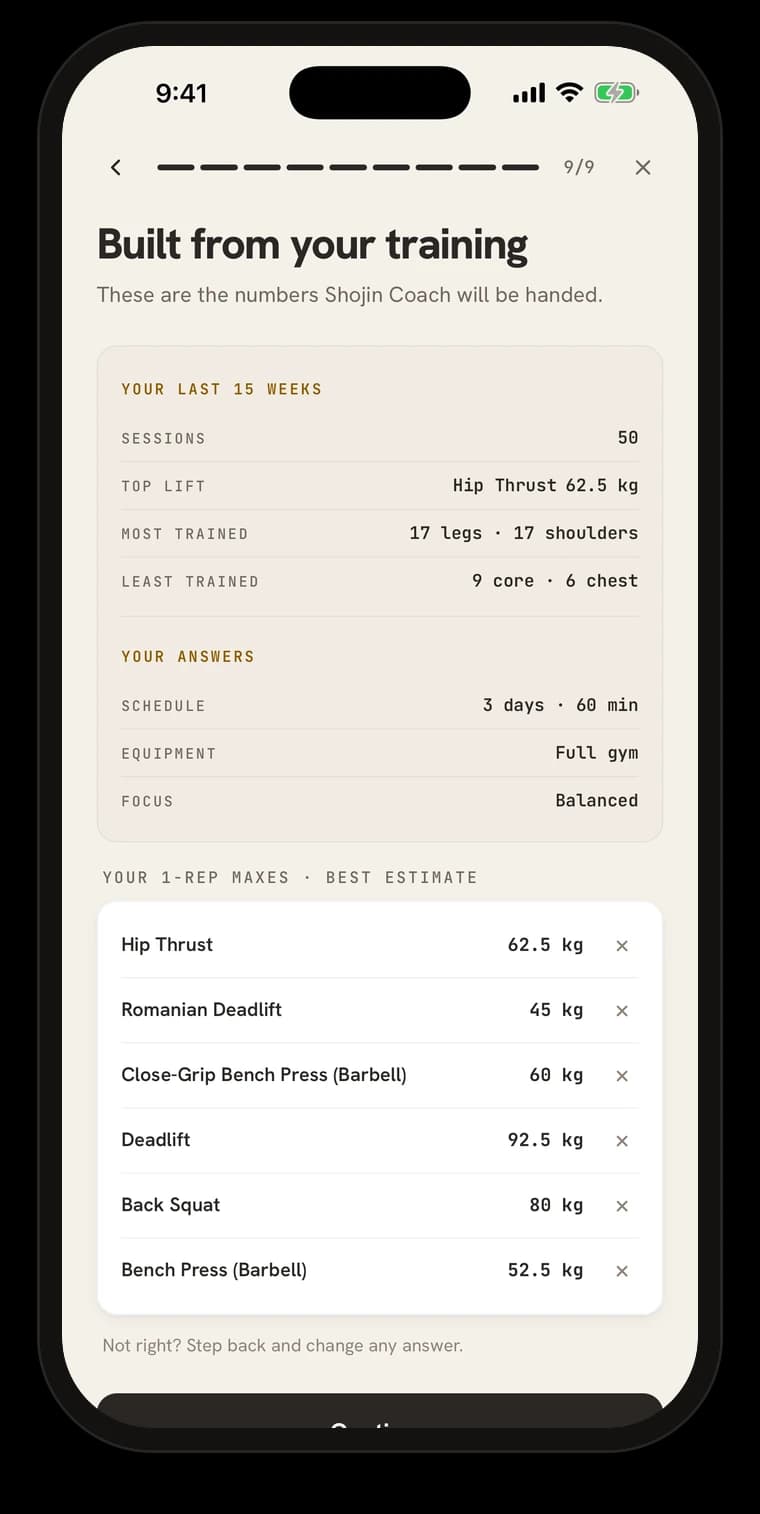
Shojin logs the way you would expect, with weight, reps and RPE on every set. What changes is what sits on top of the log.
- A program written ahead. Shojin Coach reads your logged lifts and a short quiz on your goals and schedule, then writes a science-based program of 4, 6, 8 or 12 weeks. It sits on a calendar with a Weeks and a Month view.
- Loads that move after every session. When you finish a program session, Coach compares what you did with what it asked for and adjusts the sessions still ahead. On a barbell, a load steps by twice your smallest plate, so every weight it asks for is one your rack can make.
- Effort on every set, and a check mid-session. If a set lands far from its target RPE, the rest card offers a new load for the sets still to come. You can ignore it.
- Last time on every exercise. Each exercise shows what you lifted last time and suggests the next weight from your history. We explain the method in double progression.
- A private Training Circle. Up to 12 friends see each other's training days and send high-fives.
How Coach decides the next load
Coach reads your whole session, not one set. These are the main rules, in plain terms:
| What you did | What Coach does next |
|---|---|
| Hit the top of the rep range on every working set, and no set was RPE 10 | Moves the load up one step |
| Stayed inside the rep range, and no set was RPE 10 | Asks for more reps first |
| Any set at RPE 10, in a session done as written | Holds the load |
| Fell under the rep range on a set | Brings the load down |
| Cut the session short | Holds the load, unless a set was RPE 10 on a free-weight or bodyweight compound lift, which brings it down |
A deload week keeps its lighter load. Coach adjusts only while your subscription is active.
Fitbod and Shojin side by side
The winner in each row is our call, because we make Shojin. The facts behind each row are in the sections around it.
| Fitbod | Shojin | Winner | |
|---|---|---|---|
| How the plan works | Builds each workout from recent training and muscle recovery | Writes 4, 6, 8 or 12 weeks from your own lifts, adjusts after each session | Shojin |
| See the weeks ahead | No built-in weekly planner | Weeks and Month calendar | Shojin |
| Effort | Reps in reserve, once per exercise | RPE on every set | Shojin |
| Trial | 7 days | 1 month | Shojin |
| Monthly price (Australia) | A$19.99 or A$24.99 | A$4.99 | Shojin |
| Yearly price (Australia) | A$119.99 or A$149.99 | A$34.99 | Shojin |
| Plate calculator | Yes | Yes, on the keypad | Tie |
| Free version after the trial | No | No | Tie |
| Watch | Apple Watch and Wear OS | None yet | Fitbod |
| Phone | iPhone and Android | iPhone only | Fitbod |
| Exercise library | More than 1,600, with videos | No videos; an icon for each built-in exercise | Fitbod |
| Apple Health | Reads and writes | Saves finished workouts, reads nothing | Fitbod |
| Muscle recovery | A 0 to 100% score for each muscle | None | Fitbod |
What each app costs
Fitbod. New users get a 7-day trial. After it, logging new workouts needs a paid subscription. Fitbod's Australian App Store listing shows a monthly plan at A$19.99 and at A$24.99, and a yearly plan at A$119.99 and at A$149.99. It does not say which a new user sees. Its help centre gives US$15.99 a month or US$95.99 a year, and its United States listing shows monthly plans at US$12.99 and US$15.99 and yearly plans at US$79.99 and US$95.99. The listing also carries older "Legacy Pricing" plans, so what an existing subscriber pays can differ from what a new one sees.
Shojin. One subscription, with Shojin Coach and every feature in it. New subscribers get one month free, then A$4.99 a month or A$34.99 a year at the founding price, billed by the App Store in your local currency. Shojin has no free tier after its trial either, so neither app is a free logger.
Over a year on the yearly plans, Shojin costs A$85.00 to A$115.00 less than Fitbod's Australian prices. On the monthly plans it is A$4.99 against A$19.99 or A$24.99, so about a quarter of the lower Fitbod price. Winner on price and trial length: Shojin.
Is Fitbod worth renewing at full price?
It depends on what you use. If you wear an Apple Watch or Wear OS watch, train on Android, or want a different suggested session every time you open the app, Fitbod does that and Shojin does not. If you open Fitbod to see what to lift and then follow a plan you would rather see in full, or the price is the sticking point, Shojin Coach is the closer fit. You do not have to decide on renewal day: the trial is a month, so you can run both for a few sessions and keep the one you open.
Moving from Fitbod to Shojin
Shojin has no Fitbod importer. Its CSV import reads Strong's export and Shojin's own, and tries a best-effort match on any other CSV that has an exercise, a date and weight, reps or time columns. We found no article on exporting workouts in Fitbod's help centre, so we cannot tell you where a Fitbod file would come from or what it holds.
If you cannot bring your history, you can still start. Coach puts the weight in the box for a lift you have logged. A lift you have never logged, or not for 90 days, starts empty with Coach's guide to a starting weight, so you choose the first load. Keep Fitbod through the month if you want a fallback.
Where Fitbod is ahead
- Apple Watch. Fitbod's watch app logs sets and shows your rest timer and heart rate. Starting a workout still needs your iPhone. Shojin has no Watch app yet.
- Android and Wear OS. Fitbod runs on both. Shojin is an iPhone app, though an existing account can also log in in a browser at shojin.fit.
- A bigger library with videos. Shojin has no exercise videos.
- Muscle recovery. Fitbod's 0 to 100% score for each muscle, and its heat map, have no equivalent in Shojin.
- More ways to connect. Strava, Fitbit and Health Connect work with Fitbod. Shojin has none of the three and only saves workouts to Apple Health.
- A person to ask. Fitbod's listing says trainers answer strength-training questions by email. Shojin Coach is software, and it does not offer human coaching.
Who should stay with Fitbod
Stay if any of these is true:
- You log from a watch and leave your phone in your bag.
- You train on Android.
- You like opening an app and being handed a new session, and you do not need to see the weeks ahead.
- You want muscle recovery scores to steer what you train.
If you want the plan written in advance and moving with you, you can keep Fitbod through your trial and run Shojin beside it.
Fitbod is a trademark of its owner. Shojin is not affiliated with it.
Try Shojin free for a month
Shojin is one subscription with no cap on sets. Shojin Coach is part of it: it writes your program from your own lifts and adjusts it after every session you log.
New subscribers get one month free, then A$4.99 a month or A$34.99 a year, billed by the App Store in your local currency. The subscription renews until you cancel. Cancel any time in Settings. You subscribe in the iPhone app. If you stop, your history stays, and Coach stops adjusting your program.
Common questions
Is there a Fitbod alternative with a weekly or monthly plan?
Shojin Coach writes a program of 4, 6, 8 or 12 weeks from your logged lifts and a short quiz, then shows it on a Weeks and Month calendar. Fitbod's help centre says it has no built-in weekly planner yet, and suggests building your own with Saved Workouts.
Does Fitbod have a free version?
Fitbod gives new users a 7-day trial. When it ends you can still view past workouts, but logging new ones needs a paid subscription. Shojin works the same way after its one-month trial: there is no free tier, and your history stays if you stop.
Why is Fitbod giving me less weight than last time?
Fitbod's help centre gives three reasons: the session is meant to be a lighter one, the muscle is still recovering, or you have been away and it is easing you back in. In a Shojin Coach program the load for each session ahead is on the calendar, and it changes only after a session you log.
Can I move my Fitbod history to Shojin?
Not directly. Shojin has no Fitbod importer, and we found no Fitbod help article on exporting workouts. Shojin's CSV import will try any CSV with an exercise, a date and weight, reps or time columns. Otherwise start fresh and keep Fitbod until you are sure.
Does Shojin work on Android or with an Apple Watch like Fitbod?
No. Shojin is an iPhone app and has no Watch app yet. An existing Shojin account can log in in a browser at shojin.fit, but new accounts start in the iPhone app.
These are the same answers the page’s FAQ structured data publishes: visible text, no hidden-content mismatch.
Sources
Every number in this article traces to one of these. Where the evidence is contested or thin, the article says so rather than picking a side.
- 01
Fitbod Help Centre, How Fitbod Creates Your Workout
- 02
Fitbod Help Centre, How does Fitbod adapt as I get stronger?
- 03
Fitbod Help Centre, System Requirements
- 04
Fitbod Help Centre, Apple Watch
- 05
Fitbod, AU App Store listing
- 06
Fitbod Help Centre, Why did my workout change?
- 07
Fitbod Help Centre, Save a Workout
- 08
Fitbod Help Centre, My Plan
- 09
Fitbod Help Centre, Reps in Reserve
- 10
Fitbod Help Centre, Plate Calculator
- 11
Fitbod Help Centre, How the Trial Works
- 12
Fitbod Help Centre, How to Subscribe to Fitbod
- 13
Fitbod, US App Store listing
- 14
Fitbod Help Centre search
- 15
n/a — product behaviour