Jump to a section
For muscle growth, aim for at least 10 hard sets per muscle per week, with about 20 as a common upper end for planning. Fewer sets still build muscle, and each extra set adds less than the one before. The number of days you train changes how you split those sets, not how many you need: 10 sets a week is 5 per session on two days and about 3 per session on three.
The hard part is the counting, not the number. A bench press works the chest, but it also works the triceps and the front of the shoulders. This guide gives the evidence, a table of weekly sets by goal, a table of sets per session for 2 to 6 training days, a rule for counting the muscles that help, and one full sample week.
The short answer — For growth, aim for 10 to 20 hard sets per muscle per week. Beginners can start nearer 6 to 10. To keep muscle you need about a third of that. Divide the week's sets by the number of days you train that muscle: 12 sets over 2 days is 6 per session, over 3 days is 4. Count a set that mainly works another muscle as half a set.
What does the research say about sets per week?
Four sources matter here, and they agree on the direction.
Pelland and colleagues (2025, published in Sports Medicine in 2026) is the newest. It pooled 67 studies and 2,058 people (79.1% male, average age about 25). Their models say that gains in muscle size and strength both rise as weekly volume rises, with diminishing returns. The diminishing returns are "considerably more pronounced" for strength. They also found that frequency has an effect on strength, but that its effect on muscle size is compatible with negligible.
Schoenfeld, Ogborn and Krieger (2017) pooled 15 studies, with 34 treatment groups. Each extra weekly set was linked to about 0.37% more muscle growth. Comparing the higher-volume group with the lower-volume group in each study, the difference was 3.9%. When they split volume into under 5, 5 to 9 and 10 or more sets per muscle, they found only a trend (P = 0.074), not a firm difference. They concluded that more volume gives more growth.
The 2026 American College of Sports Medicine (ACSM) position stand (Currier and colleagues) reviewed 137 systematic reviews. It found that muscle growth was enhanced by higher volumes, at 10 or more sets a week. For strength it found that gains were enhanced by 2 to 3 sets, done at least twice a week. So the two goals want different volumes: strength gains flatten sooner than size gains.
Bickel and colleagues (2011) tested how little work keeps muscle. Young adults trained for 16 weeks, then cut their training to one third or one ninth of that dose for 32 weeks. In the young adults, both cut-down doses preserved the muscle they had built. The older adults (60 to 75) did not keep their muscle size.
What the research does not give you is a ceiling. The 10-set marker has support. The figure of 20 is a planning convention: where you stop depends on your recovery, your schedule and how well you can train when you are tired. If a lift has stopped moving, more volume is only one of the possible causes. Our guide to why a lift stalls lists the others.
Two cautions about all of this. In the largest of these studies, Pelland's, 79% of the people were men and the average age was about 25, so the results fit young men best. And "set" means different things in different studies, which is why the next section defines it.
What counts as one set?
In this guide, a hard set is a working set taken close to failure, within about 3 reps of it. That definition is a convention, not a finding: studies define their sets in different ways, and the best-known volume papers count sets as the study authors reported them. Warm-up sets do not count. In the Shojin app, a set counts toward your weekly total only if you completed it and it is not a warm-up. Drop sets count.
If you do not know how close to failure a set was, our guide to RPE and RIR shows how to rate it. A set that stopped 5 reps short of failure is a lighter set, and it should not count as a full one.
How many sets per muscle per week, by goal
| Goal | Hard sets per muscle per week | Where it comes from |
|---|---|---|
| Start growing muscle (first months, or coming back) | 6 to 10 | Planning convention. It starts below the 10-set marker, so you have room to add |
| Grow muscle steadily | 10 to 15 | At or above the 10-set marker in the 2026 ACSM stand |
| Push a muscle that lags | 15 to 20 | Convention for the top of the range. Gains keep rising, but by less per set (Pelland 2025) |
| Get stronger on a lift | 2 to 3 sets of that lift, at least twice a week | 2026 ACSM stand. Strength gains flatten sooner than size gains (Pelland 2025) |
| Keep the muscle you have | About a third of your growth sets, for example 4 sets when you would normally do 12 | Bickel 2011, in young adults |
Pick one row for each muscle, not one row for your whole body. A lifter can push the back at 15 sets and keep the calves at 4. Start at the low end of your row for four to six weeks. Add a set or two to a muscle only when your lifts on it are moving up and you are recovering well.
How do I split 10 to 20 sets across 2 to 6 training days?
Divide the weekly target by the number of days you train that muscle. The table gives the sets per muscle in one session.
| Plan | Times a week each muscle is trained | 10 sets a week | 12 sets | 15 sets | 20 sets |
|---|---|---|---|---|---|
| 2 days: full body | 2 | 5 | 6 | 7 to 8 | 10 |
| 3 days: full body | 3 | 3 to 4 | 4 | 5 | 6 to 7 |
| 4 days: upper / lower | 2 | 5 | 6 | 7 to 8 | 10 |
| 5 days: upper, lower, push, pull, legs | 2 | 5 | 6 | 7 to 8 | 10 |
| 6 days: push, pull, legs, twice | 2 | 5 | 6 | 7 to 8 | 10 |
| 6 days: upper / lower, three times | 3 | 3 to 4 | 4 | 5 | 6 to 7 |
| 5 or 6 days: one muscle a day (body-part split) | 1 | 10 | 12 | 15 | 20 |
Three things to know about this table.
The number of training days is not the number of times you train a muscle. Four days of upper/lower trains each muscle twice. Six days of push/pull/legs also trains each muscle twice. Look at the second column, not the first.
Two or three times a week is the safe default. In a 2016 meta-analysis of ten studies, Schoenfeld and colleagues found that training a muscle twice a week gave more growth than once a week when the total volume was equal. Whether three times beats twice was not settled. The newer Pelland analysis found that frequency's effect on muscle size was compatible with negligible once volume is counted. Taken together: if the total is right, the split matters less than the total. Choose the split that you can keep.
The sets in the table are for one muscle. A session trains several muscles at once. On a 3-day full-body plan with a target of 12 sets for each of six muscle groups, you would not do 24 sets of direct work on each day, because many of your sets count for more than one muscle. That is the next section.
How do secondary muscles count?
A set of bench press trains the chest, and it also trains the triceps and the front of the shoulders. Counting only the main muscle undercounts the arms and shoulders of anyone who presses. Counting every muscle at full value overcounts them.
The Pelland meta-regression tested this directly. It counted the sets that trained a muscle indirectly as half a set (its "fractional" method), and that method had the strongest evidence of the ways they tried. So a bench press for the triceps is about half a triceps set.
Shojin's counting rule is a convention built on that idea. It is not a measurement, and other trackers use other rules. Each built-in exercise carries a credit for each muscle it works, in steps of 0.25 up to 1. A muscle group, such as arms or shoulders, takes the highest credit among its parts. A squat is one legs set, not one quads set plus one glutes set plus one hamstrings set. For a custom exercise with no credits, the main muscle counts as 1 and each secondary muscle as one half.
| Exercise (one set) | Main muscle | Also credited |
|---|---|---|
| Bench Press (Barbell) | Chest 1 | Arms 0.5, Shoulders 0.5, Core 0.25 |
| Overhead Press (Barbell) | Shoulders 1 | Arms 0.5, Chest 0.25, Core 0.25 |
| Lat Pulldown (Cable) | Back 1 | Arms 0.5, Shoulders 0.25 |
| Back Squat | Legs 1 | Back 0.5, Core 0.25 |
| Lateral Raise | Shoulders 1 | Nothing else |
You can try your own week in the weekly sets calculator, which uses these credits.
A sample week: 3 days of full body
Here is a 3-day full-body week of 39 sets, 13 in each session. It is a plain, sensible week, and many lifters would be happy with it. The totals show why you need to count.
| Day | Exercises (sets) |
|---|---|
| Full body A | Back Squat (3), Bench Press (Barbell) (3), Lat Pulldown (Cable) (3), Lateral Raise (2), Bicep Curl (Dumbbell) (2) |
| Full body B | Romanian Deadlift (3), Overhead Press (Barbell) (3), Seated Row (Cable) (3), Leg Curl (2), Triceps Pushdown (Cable) (2) |
| Full body C | Leg Press (3), Incline Bench Press (Dumbbell) (3), Pull Up (3), Standing Calf Raise (2), Hanging Leg Raise (2) |
Counted with the credits above, the week comes to:
| Muscle group | Sets that mainly work it | Credit from other lifts | Weekly total |
|---|---|---|---|
| Chest | 6 | 0.75 | 6.75 |
| Back | 9 | 3.5 | 12.5 |
| Legs | 13 | 0 | 13 |
| Shoulders | 5 | 5.25 | 10.25 |
| Arms | 4 | 9 | 13 |
| Core | 2 | 4.5 | 6.5 |
Chest is the gap. It gets 6.75 sets, below the 10-set marker, even though the lifter presses on two of three days. Arms get 13, but only 4 of those are direct arm sets: the rest is credit from presses, rows and pulldowns. The count also shows how generous the half-credit is. If you think a pulldown does less for the biceps, your own arm total would be lower.
The fix is small. Add 4 sets of Incline Bench Press (Dumbbell) on day B. Chest goes to 10.75, shoulders to 12.25, arms to 15 and core to 7.5, and the week is 43 sets. One extra exercise brings the weakest muscle over 10 without a fourth training day.
How Shojin uses this
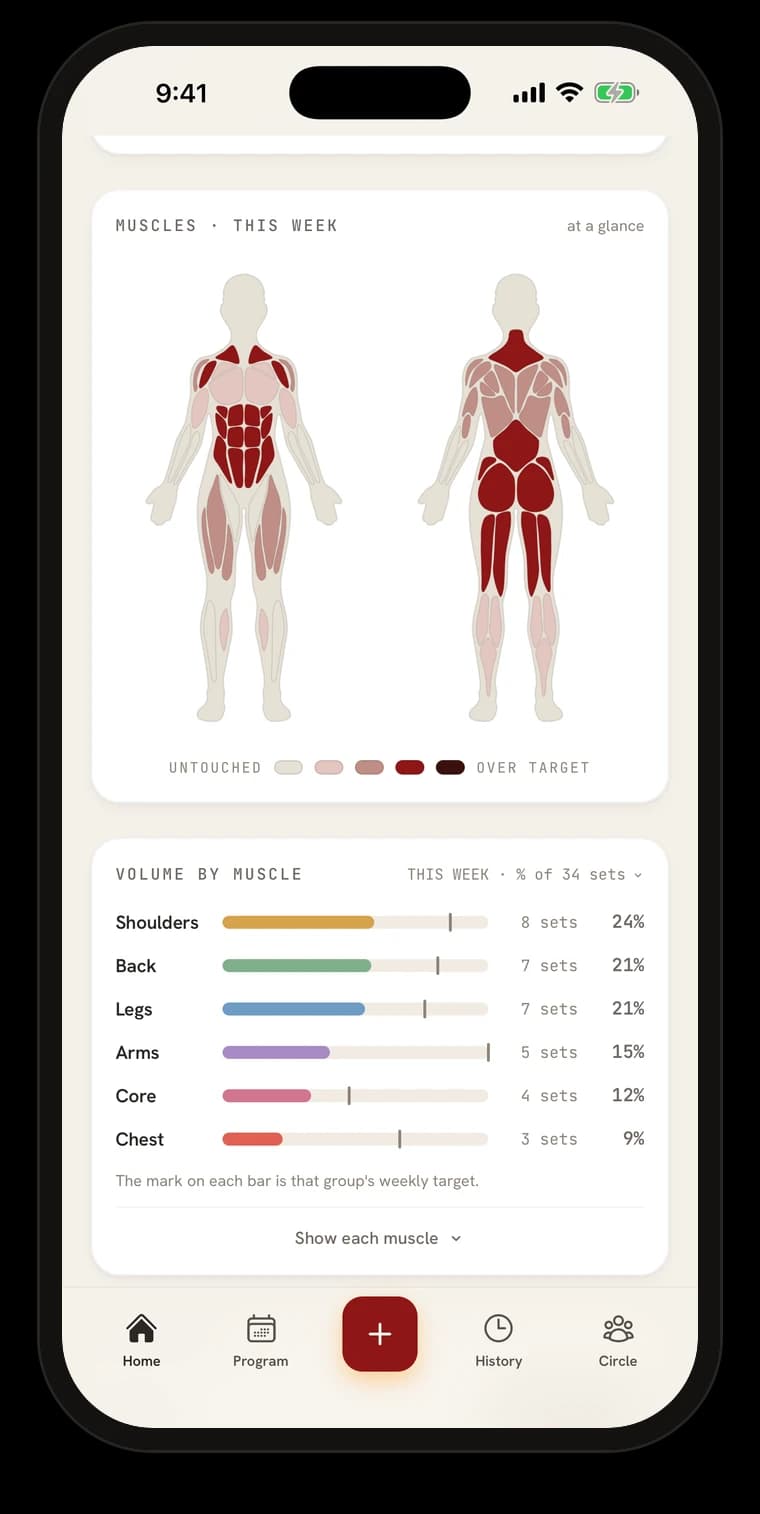
Shojin counts your weekly sets for you. Its Home screen shows each muscle group's sets for the current Monday-to-Sunday week, and a body map shaded by how much work each muscle has had. It counts only completed sets that are not warm-ups, with the credit rule above. Coach uses the same rule: it checks each week of a program it writes against a weekly sets range for every muscle group, for too few sets and for too many.
The counts are a read-out, not a verdict. A muscle can sit at 8 sets for a week because you were away on a trip, and that is fine.
Try Shojin free for a month
Shojin is one subscription with no cap on sets. Shojin Coach is part of it: it writes your program from your own lifts and adjusts it after every session you log.
New subscribers get one month free, then A$4.99 a month or A$34.99 a year, billed by the App Store in your local currency. The subscription renews until you cancel. Cancel any time in Settings. You subscribe in the iPhone app. If you stop, your history stays, and Coach stops adjusting your program.
Common questions
How many sets per muscle per week for a beginner?
Start with 6 to 10 hard sets per muscle per week. The lower number leaves you room to add sets as you adapt. That start is a planning convention rather than a finding: the research supports 10 or more sets for growth in general, not a separate beginner number. Move up when your lifts rise and you recover well.
Is 3 days of full body enough?
It can be, if the sets add up. Three sessions with 4 hard sets per muscle each reach 12 a week. The common problem is a plan with 1 to 2 sets per muscle in each session, which is only 3 to 6 a week. Count your week before you decide.
How many sets per muscle on an upper/lower split?
Each muscle is trained twice a week on an upper/lower split. For 10 to 15 sets a week, that is 5 to 8 sets per muscle in each session. A 12-set target gives 6 per session.
How many sets a week do I need to keep my muscle?
About a third of what you would do to grow. In a trial of young adults, one third of the training dose kept the muscle they had built for 32 weeks. If you grow on 12 sets, that is about 4. The result is for young adults. The older adults in the same trial did not keep their muscle size on the reduced doses.
Do I need more sets to get stronger?
Less, per lift. The 2026 ACSM stand found that strength was enhanced by 2 to 3 sets per exercise, done at least twice a week. Pelland's models also show strength gains flattening sooner as volume rises than size gains do. If you want both, a few sets on the main lifts covers the strength side, and the rest of your sets can go to growth.
Does a bench press count for my triceps?
Partly. The Pelland meta-regression counted these indirect sets as half a set and found that method had the strongest evidence. Shojin does the same: a set of bench press credits the arms with 0.5. It is a convention, so treat the total as a guide, not a measurement.
These are the same answers the page’s FAQ structured data publishes: visible text, no hidden-content mismatch.
Sources
Every number in this article traces to one of these. Where the evidence is contested or thin, the article says so rather than picking a side.
- 01
Pelland JC, Remmert JF, Robinson ZP, Hinson SR, Zourdos MC (2026). The resistance training dose response: meta-regressions exploring the effects of weekly volume and frequency on muscle hypertrophy and strength gains. Sports Medicine 56(2):481-505
- 02
Schoenfeld BJ, Ogborn D, Krieger JW (2017). Dose-response relationship between weekly resistance training volume and increases in muscle mass: a systematic review and meta-analysis. Journal of Sports Sciences 35(11):1073-1082
- 03
Currier BS, D'Souza AC, Singh MAF, et al. (2026). American College of Sports Medicine Position Stand. Resistance Training Prescription for Muscle Function, Hypertrophy, and Physical Performance in Healthy Adults: An Overview of Reviews. Medicine & Science in Sports & Exercise 58(4):851-872
- 04
Schoenfeld BJ, Ogborn D, Krieger JW (2016). Effects of resistance training frequency on measures of muscle hypertrophy: a systematic review and meta-analysis. Sports Medicine 46(11):1689-1697
- 05
Bickel CS, Cross JM, Bamman MM (2011). Exercise dosing to retain resistance training adaptations in young and older adults. Medicine & Science in Sports & Exercise 43(7):1177-1187