Jump to a section
Do 2 to 4 warm-up sets before the first heavy lift of a session, and 0 to 1 before the lifts that follow. Use 2 sets for a light working weight, 3 for a middling one and 4 for a heavy one. Start on the empty bar, add weight in steps, and cut the reps as the load rises.
The short answer: For your first heavy lift, do 2 warm-up sets under 60 kg (135 lb), 3 from 60 kg to under 100 kg (225 lb), and 4 from 100 kg up. Each set is heavier and shorter than the one before, and the last lands at 60 to 85% of your working weight. For the second and third lifts of the session, 0 to 1 set is usually enough.
The right number depends on how heavy your first working set is, not on the lift.
A 40 kg bench press needs less of a ramp than a 140 kg squat. These numbers are a coaching convention, not a research finding. Below are the thin evidence, ramp tables in kilograms and pounds, notes for bench, squat and deadlift, and the cases where one set or none is enough.
What does the research say about warm-up sets?
Little of it is about warm-up sets in the gym, so most ramps, including the ones here, are coaching convention.
General warm-ups do help. A 2010 systematic review (Fradkin, Zazryn and Smoliga) covered 32 studies. Warming up improved performance in 79% of the outcomes measured. The authors found few well-run randomised trials. Those studies looked at sport and exercise tasks in general, not at barbell warm-up sets.
Warm-up design is mostly experience. A 2015 review (McGowan and colleagues) said warm-up strategies have developed largely by trial and error, using coach and athlete experience rather than scientific evidence, though they noted newer research was filling the gap.
A heavier last warm-up set may help. Two small trials of resistance-trained men point that way, and a third found no gain beyond the first set. All three are small, so treat them as hints.
- Viveiros and colleagues (2024) tested 15 men. They warmed up at 40%, 60% or 80% of their ten-rep max, for 15, 10 or 5 reps, before three lifts of three sets to failure. The 80% warm-up gave more total training volume than the other two. The authors recommended warming up each exercise at 80% of the initial workout load.
- Ribeiro and colleagues (2020) tested 40 men on squat and bench press. Six reps at 80% of the training load gave higher squat bar speed than six reps at 40%. On bench press, two sets, 40% then 80%, did best. The authors concluded that a few reps at low loads were not enough.
- Souza and colleagues (2024) tested 14 men on the back squat. One set of three reps at 90% of a one-rep max did not raise total reps or total volume compared with a usual warm-up. It did give more volume in the first set, and the authors concluded it did not improve the session over a usual warm-up.
None of this gives you a count. We found no trial that settles whether 2, 3 or 4 sets is best. The rule here, more sets for heavier loads with a last set near the working weight, fits these hints and common practice. It is not proven.
How many warm-up sets before working sets?
Do 2, 3 or 4 warm-up sets, more as the first working weight gets heavier. The table shows the rule Shojin uses on Auto. It is a convention that many coaches would recognise.
| First working weight | Warm-up sets (kg) | Warm-up sets (lb) |
|---|---|---|
| Under 60 kg or 135 lb | 2 | 2 |
| 60 kg or 135 lb, up to under 100 kg or 225 lb | 3 | 3 |
| 100 kg or 225 lb and up | 4 | 4 |
The heavier the load, the more steps it takes to go from the bar to the working weight without a big jump. One coach, Hunter Labrada, describes 4 to 5 warm-up sets before his first two lifts and one set before the rest (BarBend, 2023). He says the percentages are guidelines. If you are short on time, the 2-set ramp keeps the shape and costs little.
What does a warm-up ramp look like with real loads?
A ramp starts on the empty bar, then rises in steps while the reps fall. These are the loads Shojin builds for a 100 kg and a 60 kg first working set, on a 20 kg bar with 2.5 kg steps.
| Set | Load | Reps | Share of 100 kg |
|---|---|---|---|
| Warm-up 1 | 20 kg (empty bar) | 10 | 20% |
| Warm-up 2 | 40 kg | 5 | 40% |
| Warm-up 3 | 60 kg | 3 | 60% |
| Warm-up 4 | 80 kg | 2 | 80% |
| Working sets | 100 kg | your target | 100% |
| Set | Load | Reps | Share of 60 kg |
|---|---|---|---|
| Warm-up 1 | 20 kg (empty bar) | 10 | 33% |
| Warm-up 2 | 30 kg | 5 | 50% |
| Warm-up 3 | 45 kg | 3 | 75% |
| Working sets | 60 kg | your target | 100% |
The same working weight can take a shorter or longer ramp. Here is the 100 kg lift with 2, 3 or 4 warm-up sets.
| Warm-up sets | What you lift |
|---|---|
| 2 | 20 × 10, 60 × 5 |
| 3 | 20 × 10, 50 × 5, 75 × 3 |
| 4 | 20 × 10, 40 × 5, 60 × 3, 80 × 2 |
Two things hold in every ramp. The reps fall as the load rises, so the heavy steps stay quick. And the last warm-up set is below the working weight, so the first working set is the first set that is hard.
Pounds follow the same shape on a 45 lb bar with 5 lb steps. For a 135 lb first set: 45 × 10, 65 × 5, 100 × 3. For 225 lb: 45 × 10, 90 × 5, 135 × 3, 180 × 2.
How many warm-up sets for bench press?
For a bench press, use 2 to 3 warm-up sets for most lifters, and 4 from 100 kg. At an 80 kg first set the ramp is 20 × 10, 40 × 5, 60 × 3. The empty bar is the cheapest set of the ramp, and it lets you rehearse the bar path before any weight is on.
How many warm-up sets for squats?
Squats are usually the heaviest lift in the session, so 3 to 4 warm-up sets is typical. At a 120 kg first set the ramp is 20 × 10, 47.5 × 5, 70 × 3, 95 × 2.
How many warm-up sets for deadlift?
For a deadlift from the floor, use 3 to 4 warm-up sets, and skip the empty bar. An empty bar sits too low to pull from, so the ramp starts with plates on. At a 160 kg first set the ramp is 62.5 × 5, 87.5 × 3, 110 × 2, 135 × 1.
A Romanian or stiff-leg deadlift starts from standing, so it can keep the empty-bar set. A common approach is to do fewer deadlift warm-up sets if you squatted first, because the back and hips are already warm. Judge that by feel.
When are fewer warm-up sets enough?
One set, or none, is enough when the muscles are already warm and the weight is far below your limit. These are conventions, not rules.
- Your second and third lifts. If you bench, then do an incline press, you are already warm. One set at 50 to 75% of the working weight is a common choice.
- A light first set. Near the bar, there is little to ramp through. A 25 kg first set needs the empty bar and nothing else.
- Dumbbell, cable and machine work. These start light by nature. Many lifters use the first working set at an easy effort as the warm-up. Our guide to RPE and RIR shows how to rate that set.
- Short on time. Pick the 2-set ramp. It keeps an empty-bar set and one set near the working load.
Add a set, not reps, when a lift feels stiff, you are returning from a break, or the first working weight is close to a personal best.
Keep the ramp short. Each step has fewer reps than the one before, so the warm-up does not tire you before the working sets. A few minutes of easy cardio or the first movement done light, before the ramp, is a common way to start.
Do warm-up sets count as working sets?
No. Warm-up sets are not hard sets, so they do not count toward your weekly sets per muscle. Our guide to sets per muscle per week uses the same rule.
Early warm-up sets need little rest. Take a little longer before the last one. Rest for the working sets is in our guide to rest between sets, and once the ramp is done, how much weight to add covers the working weight.
How does Shojin add warm-up sets?
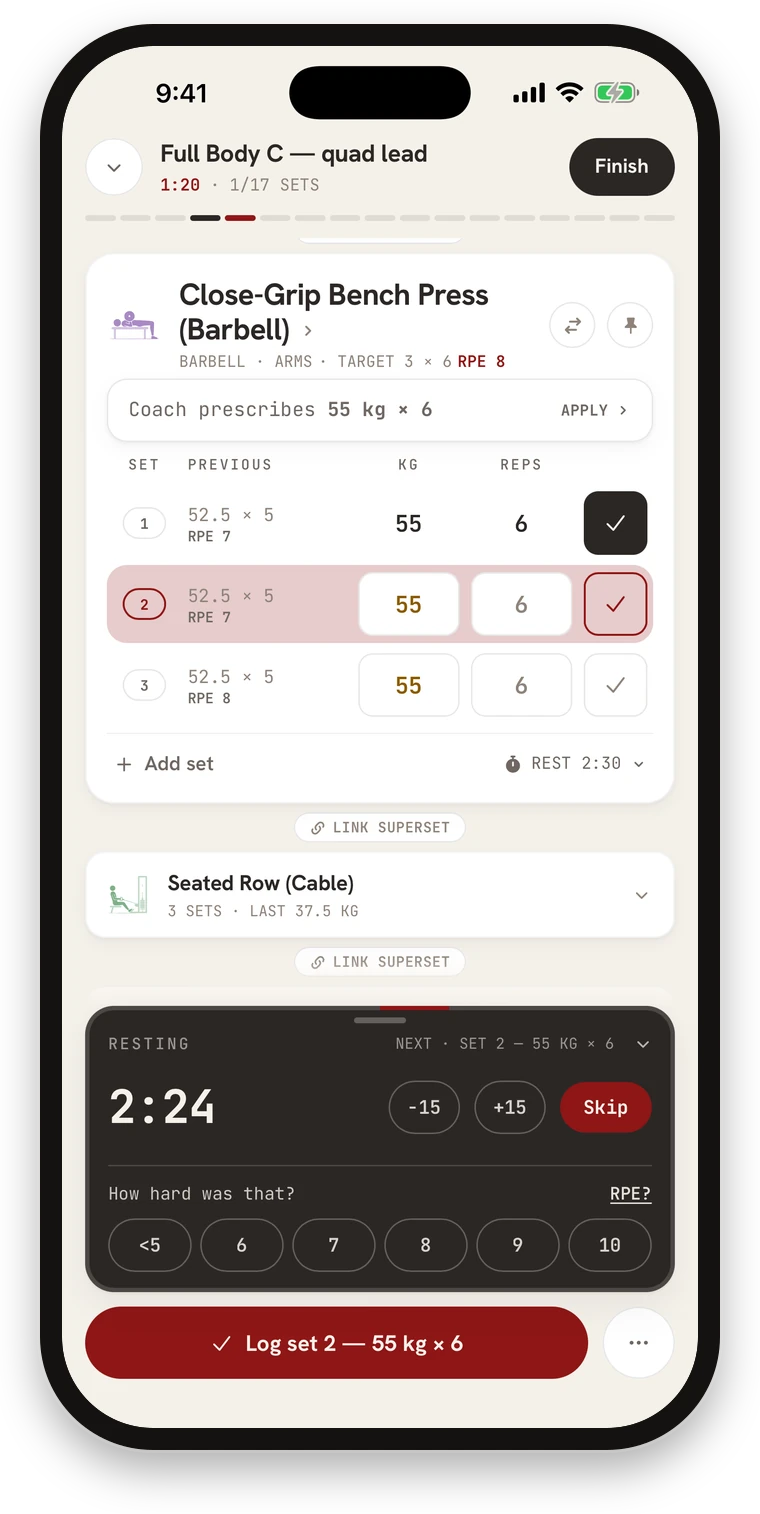
Shojin builds the ramp for you from your first working set. On an exercise in the workout logger, open the ⋯ menu and tap "Add warm-up sets". The row shows how many sets it will add. The sets go in before your first working set, and a toast offers Undo.
- It uses your load. The ramp is cut from the load in your first working set: what you typed, otherwise the program's, otherwise last session's.
- Profile → Training → "Warm-up sets" offers Auto, 2, 3 or 4. Auto follows the table above.
- A bar lift starts on the empty bar for 10 reps, then rises by percentages: 40%, 60% and 80% on 4 sets, 50% and 75% on 3, 60% on 2. Deadlifts from the floor and Smith machine lifts have no empty-bar set, so every set is a percentage.
- Loads round down, to weights you can build. A set labelled 60% never loads more than 60%, and each load is built from the plate rack in your profile (a standard rack until you change it).
- Only barbell lifts get a ramp: squat, hinge, lunge, press and row patterns, plus the Smith machine. Dumbbell, cable, other machine, body-weight, timed, landmine and T-bar lifts do not.
- The row appears only on a new workout, before any set of that lift is logged and when it has no warm-up set yet. A routine that carries its own warm-up sets keeps them.
- Warm-up sets stay out of your numbers. They do not count toward working-set volume or personal records, and they do not start the rest timer.
Try Shojin free for a month
Shojin is one subscription with no cap on sets. Shojin Coach is part of it: it writes your program from your own lifts and adjusts it after every session you log.
New subscribers get one month free, then A$4.99 a month or A$34.99 a year, billed by the App Store in your local currency. The subscription renews until you cancel. Cancel any time in Settings. You subscribe in the iPhone app. If you stop, your history stays, and Coach stops adjusting your program.
Common questions
How many warm-up sets should I do for bench press?
Do 2 to 3 for most first working weights, and 4 from 100 kg. A 3-set ramp for an 80 kg bench is 20 × 10, 40 × 5 and 60 × 3.
How many warm-up sets should I do for squats?
Do 3 to 4 for a typical working weight. For a 120 kg squat, that is 20 × 10, 47.5 × 5, 70 × 3 and 95 × 2.
How many warm-up sets should I do for deadlift?
Do 3 to 4, and start with plates on the bar when you pull from the floor. For a 160 kg deadlift, one ramp is 62.5 × 5, 87.5 × 3, 110 × 2 and 135 × 1.
Do I need warm-up sets for every exercise?
No. Do the full ramp on your first heavy lift. For later lifts that use the same muscles, 0 to 1 set is usually enough, and light dumbbell, cable and machine work can start with an easy first set.
Do warm-up sets count as working sets?
No. Warm-up sets are not hard sets, so they stay out of your weekly set counts and your records. Shojin tags them as warm-ups and leaves them out of both.
These are the same answers the page’s FAQ structured data publishes: visible text, no hidden-content mismatch.
Sources
Every number in this article traces to one of these. Where the evidence is contested or thin, the article says so rather than picking a side.
- 01
Fradkin AJ, Zazryn TR, Smoliga JM (2010). Effects of warming-up on physical performance: a systematic review with meta-analysis. Journal of Strength and Conditioning Research 24(1):140-148
- 02
McGowan CJ, Pyne DB, Thompson KG, Rattray B (2015). Warm-up strategies for sport and exercise: mechanisms and applications. Sports Medicine 45(11):1523-1546
- 03
Viveiros L, Gioia K, Nasser I, Acetto V, Farias D, Willardson JM, Miranda H (2024). High-load and low-volume warm-up increases performance in a resistance training session. Journal of Bodywork and Movement Therapies 40:1487-1491
- 04
Souza D, Silva AG, Vale A, Pessoni A, Galvão L, et al (2024). Effect of warm-up protocols using lower and higher loads on multiple-set back squat volume-load. PeerJ 12:e17347
- 05
Ribeiro B, Pereira A, Neves PP, Sousa AC, Ferraz R, Marques MC, Marinho DA, Neiva HP (2020). The role of specific warm-up during bench press and squat exercises: a novel approach. International Journal of Environmental Research and Public Health 17(18):6882
- 06
BarBend, article on Hunter Labrada's warm-up advice (page last updated 3 August 2023)