Jump to a section
Add the smallest jump your equipment allows, about 2.5 kg (5 lb) on a barbell and 2 kg (5 lb) on dumbbells, each time you beat your rep target with a rep or two to spare. Let your sets decide when, not the calendar. A newer lifter may earn that jump every week, or even every session. A trained lifter earns it far less often, because strength gains slow down with experience.
The size of the jump matters as much as how often you take it. On a 100 kg squat, 2.5 kg is 2.5% more. On a 12 kg dumbbell, the next pair up is 14 kg, which is 17% more. That one fact explains most of the confusion about when to add weight on dumbbells and machines.
The short answer — Add one smallest step (2.5 kg or 5 lb on a barbell) when every working set hits your rep target with at least one rep left. If that step is more than about 10% of the load, as it is on most dumbbells and machines, add reps first and move the weight when the reps reach the top of your range.
How much weight should you add each time?
The smallest jump depends on the equipment:
- Barbell. Plates go on in pairs, so the smallest jump is twice the smallest plate. With 1.25 kg plates that is 2.5 kg. With 2.5 lb plates it is 5 lb.
- Dumbbells. The jump is the next pair on the rack. In kilogram gyms that is often 2 kg or 2.5 kg. In pound gyms it is usually 5 lb, and sometimes 2.5 lb on the light end.
- Machines and cables. The jump is one plate of the stack. Stacks differ: a small stack may be built from 10 lb plates and a larger one from 15 lb plates. The tables use 5 kg and 10 lb plates as examples.
Here is each jump as a share of a typical working load. The loads are examples, not targets.
In kilograms
| Lift | Working load | Smallest jump | Jump as % of load |
|---|---|---|---|
| Barbell back squat | 100 kg | 2.5 kg | 2.5% |
| Barbell bench press | 60 kg | 2.5 kg | 4.2% |
| Bench press with 0.5 kg change plates | 60 kg | 1 kg | 1.7% |
| Dumbbell, per hand | 12 kg | 2 kg | 16.7% |
| Dumbbell, per hand | 20 kg | 2 to 2.5 kg | 10 to 12.5% |
| Machine, 5 kg plates | 40 kg | 5 kg | 12.5% |
| Cable, 5 kg plates | 20 kg | 5 kg | 25% |
In pounds
| Lift | Working load | Smallest jump | Jump as % of load |
|---|---|---|---|
| Barbell back squat | 225 lb | 5 lb | 2.2% |
| Barbell bench press | 135 lb | 5 lb | 3.7% |
| Bench press with 0.5 lb fractional plates | 135 lb | 1 lb | 0.7% |
| Dumbbell, per hand | 25 lb | 2.5 to 5 lb | 10 to 20% |
| Dumbbell, per hand | 45 lb | 5 lb | 11.1% |
| Machine, 10 lb plates | 90 lb | 10 lb | 11.1% |
| Cable, 10 lb plates | 40 lb | 10 lb | 25% |
The American College of Sports Medicine's 2009 position stand gave a rule for the size of a jump. It said to add 2 to 10% to the load once you could do one or two reps more than your target on two sessions in a row, with the smaller jumps on small-muscle lifts. A barbell squat fits that rule easily. A dumbbell under 20 kg does not: the next pair up is already 10% or more. In 2026 the ACSM replaced that stand, and the new one does not repeat the 2 to 10% figure.
Why dumbbell and machine lifts go up by reps first
A bigger jump costs more reps. You can estimate how many with the Epley formula, which turns a set into an estimated one-rep max (1RM): weight × (1 + reps ÷ 30). Then work it backwards for the heavier weight.
| Set today | One step heavier | Reps to expect at the same effort |
|---|---|---|
| Squat 100 kg × 5 | 102.5 kg | about 4 |
| Bench 60 kg × 8 | 62.5 kg | about 6 |
| Dumbbell 20 kg × 10 | 22 kg | about 6 |
| Dumbbell 12 kg × 12 | 14 kg | about 6 |
| Machine 40 kg × 12 | 45 kg | about 7 |
| Cable 20 kg × 12 | 25 kg | 3 or 4 |
On the squat, one step costs about one rep. On a 12 kg dumbbell, it costs about half the set. Rep formulas are less accurate above about 10 reps, so treat the last rows as rough. The pattern is still clear.
So on small lifts the reps carry the progress. Use a wide rep range, such as 8 to 12 or 10 to 15, and add reps at one weight until every set reaches the top. Then take the jump and start again near the bottom. This is double progression, and our guide to double progression works through it. Adding reps is real progress. In an eight-week trial in trained adults, a group that added reps at a fixed weight gained about as much strength and muscle as a group that added weight.
How fast can beginners and trained lifters add weight?
Strength gains slow down as you train longer. A 2004 review summed up studies that ran from 4 weeks to 2 years. Strength rose by about:
- 40% in untrained people
- 20% in moderately trained people
- 16% in trained people
- 10% in advanced lifters
- 2% in elite lifters
These are not weekly rates, and the studies used different programs and tests, so treat them as rough. They do show the shape: an untrained lifter gains about two and a half times as much as a trained one over similar periods.
In practice, a new lifter can often add one barbell step every session for the first weeks on lifts like the squat. A lifter several years in may hold one weight for weeks while the reps climb. Both of those are coaching conventions, not study results. The research says something simpler. The ACSM's 2026 stand found that you can benefit from training without progression, but that continued long-term progress probably needs a stimulus that keeps rising. It also notes that rating your effort is one way to raise the load as you get stronger.
A 4-week example: the barbell squat
Here is a newer lifter who squats twice a week, 3 sets of 5. The rule is simple: add one step after a session unless the hardest set hit RPE 10, which means no rep was left. Our guide to RPE and RIR explains the scale.
| Session | kg | lb | Reps | Hardest set | Next session |
|---|---|---|---|---|---|
| Week 1, Mon | 80 | 175 | 5, 5, 5 | RPE 7 | Add a step |
| Week 1, Thu | 82.5 | 180 | 5, 5, 5 | RPE 7 | Add a step |
| Week 2, Mon | 85 | 185 | 5, 5, 5 | RPE 8 | Add a step |
| Week 2, Thu | 87.5 | 190 | 5, 5, 5 | RPE 8 | Add a step |
| Week 3, Mon | 90 | 195 | 5, 5, 5 | RPE 9 | Add a step |
| Week 3, Thu | 92.5 | 200 | 5, 5, 4 | RPE 10 | Hold |
| Week 4, Mon | 92.5 | 200 | 5, 5, 5 | RPE 9 | Add a step |
| Week 4, Thu | 95 | 205 | 5, 5, 5 | RPE 9.5 | Add a step |
Over four weeks the squat went from 80 kg to 95 kg (175 lb to 205 lb), 15 kg in all: 5 kg in every week but the one with the hold. One hard session caused one hold, and the lifter got the reps back at the same weight. That is normal.
This pace does not last. The effort creeps up: RPE 7 in week 1, RPE 9 to 9.5 by week 4. When the hardest set reaches RPE 10 most sessions, the weekly jump stops working. At that point most lifters slow down: they add reps first, or take a smaller jump. If the reps start to fall at the same weight across two or three sessions, read our guide to why a lift stalls.
How much weight to add when you lower the reps
When a program moves you to fewer reps, you can lift more. Near 5 to 12 reps, each rep you drop adds about 2.5 to 3% to the load, by the Epley formula. Start from your last set, then round down to a weight you can load.
| From 60 kg × 12 | Load | From 135 lb × 12 | Load |
|---|---|---|---|
| 10 reps | 62.5 kg | 10 reps | 140 lb |
| 8 reps | 65 kg | 8 reps | 145 lb |
| 6 reps | 70 kg | 6 reps | 155 lb |
The formula is an estimate, and it is least accurate from sets above 10 reps. Rounding down leaves room for that error. Your first session at the new reps tells you the rest.
What to do when the jump is too big
- Use smaller plates. Change plates and fractional plates are sold in pairs. A pair of 0.5 kg plates turns a 2.5 kg barbell jump into 1 kg, and a pair of 0.25 kg plates makes it 0.5 kg. In pounds, fractional plates go down to 0.25 lb each. This helps most on the bench press and overhead press, where 2.5 kg is a large share of the load.
- Add a small weight to the stack. Add-on weights for selector stacks exist, such as a 5 lb plate that sits on top of a stack built from 10 lb plates. Check that it fits your machine first.
- Add reps first. Climb a rep range at one weight, as above. This is the only option on fixed dumbbells.
- Wait for a buffer: the 2-for-2 rule. A common coaching rule, usually credited to the National Strength and Conditioning Association's textbook, says to add weight when you can do two more reps than your target on the last set, in two workouts in a row. The two-rep buffer is what pays for the jump. On a barbell, two spare reps easily cover a step that costs one. On a 12 kg dumbbell, the jump costs about six, so a two-rep buffer is not enough: use the top of a wide rep range instead.
- Compare machines by their own numbers. Some cable machines use a 2:1 pulley, where the handle carries about half the stack, and others use 1:1. The same pin on two machines can be a different load, so track each machine as its own lift.
How Shojin picks the next weight
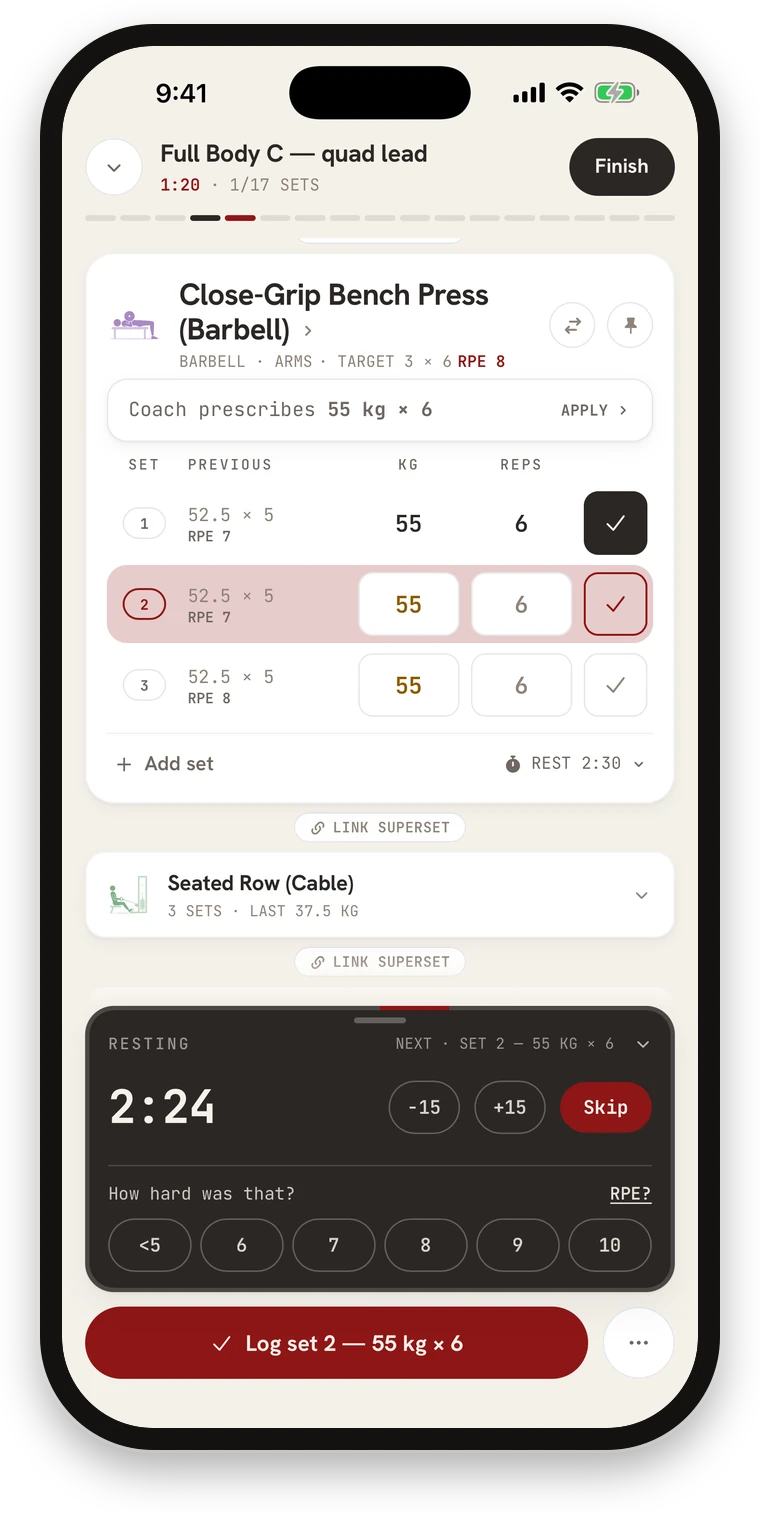
Shojin suggests the next load for each lift from your own logged sets. Here is what the code does.
- The step depends on the equipment. A barbell moves in twice the smallest plate in your rack. With the standard rack that is 2.5 kg (5 lb). Dumbbells move in 2 kg. Machines, cables and other equipment move in 2.5 kg. In pounds, everything that is not a barbell moves in 5 lb.
- You can change the step. Profile → Plate & rounding offers Auto, or 1, 2.5 or 5 kg (1, 5 or 10 lb). Auto uses each equipment's own step. A barbell can never go finer than your rack allows. To get 1 kg barbell jumps, add 0.5 kg plates under Rack & plates.
- Effort decides first. Shojin reads the hardest set at last session's top weight. If it was RPE 9 or 10 and you did fewer reps than the session before at the same weight, it suggests about 5% less. Otherwise, RPE 10 holds the weight and anything easier adds one step.
- Without RPE, your reps decide, and the default is to hold. Reps that climb at the same weight are left to climb. Once they reach the top of the range (12 reps on a barbell lift, 15 on others), or stay flat for two sessions, Shojin adds a step.
- The plan's reps come first. If a template or program asks for more reps than every set gave last time, the weight holds while you climb the reps.
- Every number is one you can load. A weight that is off the grid moves to the next weight on it. For example, a 9 kg dumbbell steps up to 10 kg, not 11.
- Machines snap to your own stack. In a Shojin Coach program, a machine or cable weight that your machine may not have is shown as the nearest weight you have logged on it at least twice in the last six months, when that weight is less than half a step away.
To see how the log turns into these numbers over weeks, read our guide to tracking progressive overload.
Limits of the evidence
We found no trial that tested how big each jump should be. The 2 to 10% rule came from a position stand, and the 2-for-2 rule comes from coaching practice. The rep costs in this guide come from one formula, which is an estimate and is rougher above 10 reps. The strength-gain figures are a narrative summary of studies with different programs. Shojin's thresholds, such as RPE 10 to hold and about 5% to back off, are working conventions, not values a trial has tested.
Try Shojin free for a month
Shojin is one subscription with no cap on sets. Shojin Coach is part of it: it writes your program from your own lifts and adjusts it after every session you log.
New subscribers get one month free, then A$4.99 a month or A$34.99 a year, billed by the App Store in your local currency. The subscription renews until you cancel. Cancel any time in Settings. You subscribe in the iPhone app. If you stop, your history stays, and Coach stops adjusting your program.
Common questions
Should I increase the weight every week?
Only if your sets say you are ready. A fixed weekly jump works for a while on big barbell lifts for a newer lifter. On small lifts, and later in training, it outruns your strength, and you end up grinding or losing reps. Add weight when every set reaches your target with a rep or two left.
Is adding 5 kg a week realistic?
On a beginner's squat or deadlift, for a few weeks, it can be: that is two 2.5 kg steps a week. On a 60 kg bench press, 5 kg a week is more than 8% each week and stalls quickly. Most upper-body lifts move slower than lower-body lifts, so a smaller jump or a pair of change plates helps there.
Should upper and lower body lifts go up by the same amount?
The same plate is a different share of each lift. 2.5 kg is 2.5% of a 100 kg squat and 4.2% of a 60 kg bench press. The ACSM's 2009 stand also said to use smaller jumps on small-muscle lifts. So the bench usually takes a step less often, or a smaller one.
Should I add the weight to every set at once?
You can add it to every working set when all of them reached the target. If only some sets reach the new weight's target, keep that weight and let the other sets catch up. Moving the first set up alone, and the others as they earn it, also works on a rep range.
What if my gym's machine jumps 7 kg a plate?
A 15 lb (about 7 kg) plate is common on some stacks. Use a higher rep range on that machine so the reps can absorb the jump, or use an add-on weight if the machine takes one. You can also switch to a cable or dumbbell version of the lift for finer steps.
These are the same answers the page’s FAQ structured data publishes: visible text, no hidden-content mismatch.
Sources
Every number in this article traces to one of these. Where the evidence is contested or thin, the article says so rather than picking a side.
- 01
American College of Sports Medicine (2009). Progression models in resistance training for healthy adults. Medicine & Science in Sports & Exercise 41(3):687–708
- 02
Currier BS, D'Souza AC, Singh MAF, et al. (2026). American College of Sports Medicine Position Stand. Resistance Training Prescription for Muscle Function, Hypertrophy, and Physical Performance in Healthy Adults: An Overview of Reviews. Medicine & Science in Sports & Exercise 58(4):851–872
- 03
Kraemer WJ, Ratamess NA (2004). Fundamentals of resistance training: progression and exercise prescription. Medicine & Science in Sports & Exercise 36(4):674–688
- 04
Plotkin D, Coleman M, Van Every D, et al. (2022). Progressive overload without progressing load? The effects of load or repetition progression on muscular adaptations. PeerJ 10:e14142
- 05
Mayhew JL, Johnson BD, LaMonte MJ, et al. (2008). Accuracy of prediction equations for determining one repetition maximum bench press in women before and after resistance training. Journal of Strength and Conditioning Research 22(5):1570–1577
- 06
Reynolds JM, Gordon TJ, Robergs RA (2006). Prediction of one repetition maximum strength from multiple repetition maximum testing and anthropometry. Journal of Strength and Conditioning Research 20(3):584–592
- 07
Rogue Fitness, Rogue Calibrated KG Steel Change Plates
- 08
Rogue Fitness, Rogue LB Fractional Plates
- 09
Eleiko XF Dumbbell
- 10
Eleiko Evo Dumbbell (Fixed)
- 11
Body-Solid, 50 lb Selectorized Weight Plate Stack
- 12
Body-Solid, 300 lb Selectorized Weight Plates
- 13
BodyCraft 5 lb Add-On Weight (Iron Company)
- 14
Rogue Fitness, FM-HR Functional Trainer weight stack assembly