Jump to a section
A good Jefit alternative depends on what you miss. Shojin is an iPhone workout tracker that rates effort on every set, which Jefit does only once per session, and Shojin Coach writes a 4 to 12 week program from your own lifts. Jefit has the bigger library, Android and a free tier.
The short answer: Pick Shojin if you want RPE on every set and a program that adjusts after each session you log, at A$4.99 a month. Pick Jefit if you want a free version, a library of more than 1,400 exercises with video, Android, a watch app or Strava.
We make Shojin, so read this as our view. Every fact about Jefit comes from Jefit's own pages, checked on 5 November 2026 and linked in the sources. Apps change often, so check before you buy.
| Quick verdict | Who it fits | |---|---| | Choose Shojin if… | You want to rate effort on every set, not once at the end.
You want a 4, 6, 8 or 12 week program written from your own lifts and adjusted after each session, plus the plates for each side on the keypad. You also get a one-month trial and a founding price about a quarter of Jefit Elite's. |
| Choose Jefit if… | You want a free version that logs without Elite. Or you train on Android, wear a watch, sync with Strava, or want a very large exercise library with an HD video for each lift. |
|---|
Is there a better app than Jefit?
It depends on what Jefit leaves out for you. Jefit is a big, mature app with a free tier, and for many lifters it is the right one. Shojin is better only on a short list: effort on every set, a program that adjusts after each session, plate maths on the keypad and a lower price.
If you only want a fast logger for a program you already run, our Strong app alternative guide is the closer match. Our Fitbod alternative guide covers the app that picks one workout at a time, and our workout tracker comparison puts five apps side by side.
What does Jefit do well?
Jefit's FAQ says every account includes full logging, the rest timer, supersets, the 1,400+ exercise library with demo videos, full history and personal records. Elite, it says, is for programming and in-depth analysis.
It runs on iPhone, Android, Apple Watch, Wear OS and the web. It syncs workouts, calories, heart rate and body weight with Apple Health on iPhone and Health Connect on Android, and it syncs with Strava both ways. A muscle recovery chart shows how recovered each muscle is, and it is in every account.
You can mark a set as warm-up, working, failure or drop. The rest timer starts after each set, and on iPhone a Live Activity shows it on the lock screen. Its Australian App Store listing shows 4.7 stars from 4.3K ratings.
Where does Jefit fall short?
- Effort is rated once per session. Jefit's FAQ says you "give one effort rating (RPE) for the whole session, not one per set". Jefit's own blog says the same: RPE is "logged at the session level, not per individual set". The cost is that you cannot tell which set was the grinder.
- No plate calculator. Jefit's own comparison post lists the plate calculator as something "Jefit doesn't have". Jefit does round its plan targets to the plates and dumbbells you tell it you own.
- The programming is Elite. Jefit's FAQ says the 12 week Adaptive Plan and the weight suggestions from Load Progression need Elite. Free accounts keep 2 plans, 7 custom exercises, 10 Instant Workouts and 3 watch sessions.
- The Adaptive Plan updates weekly. Jefit's FAQ says it updates weekly from your logged workouts, in three four week blocks.
What does a Jefit alternative with RPE on every set look like?
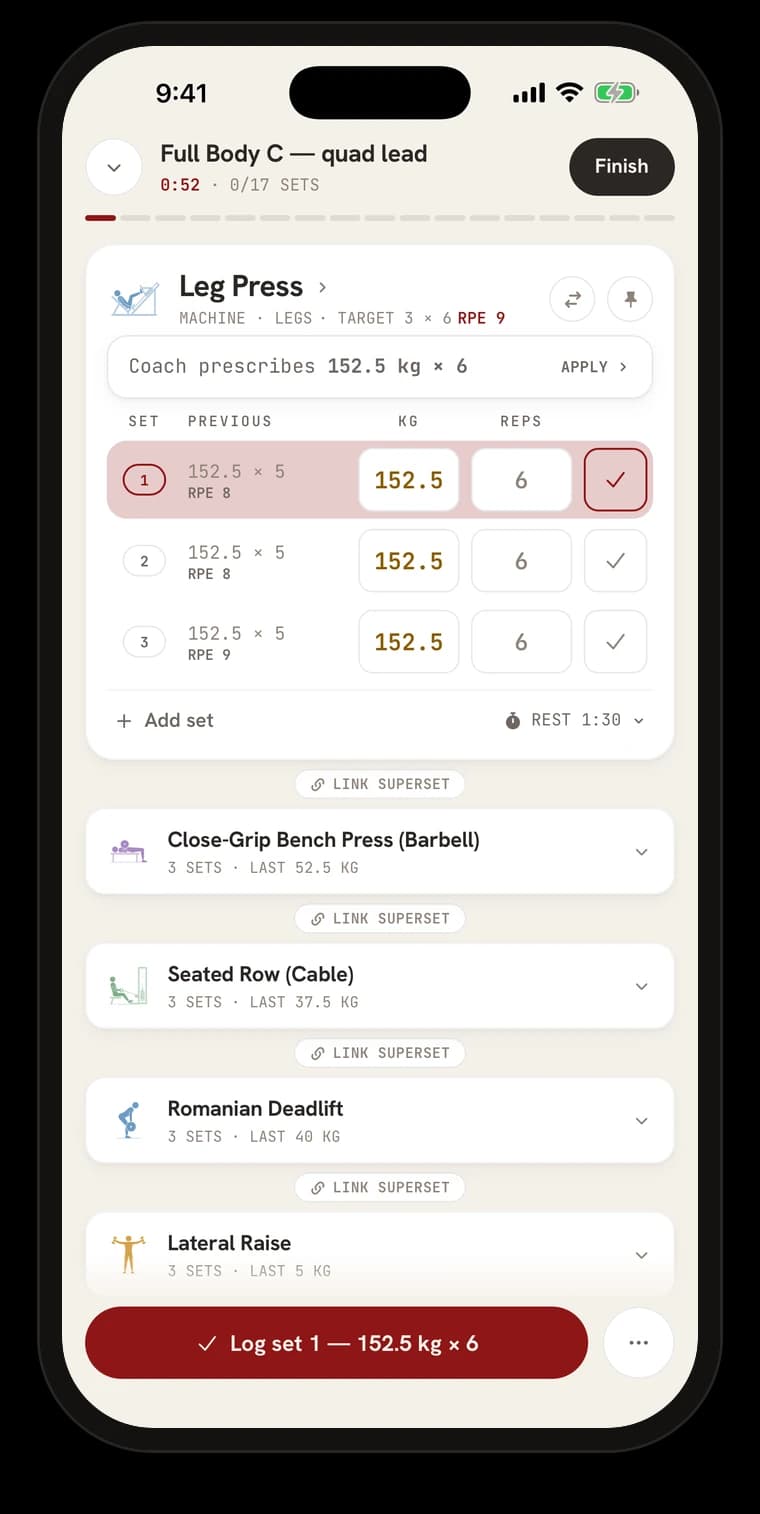
Shojin logs weight, reps and RPE for each set. The RPE sits on the set keypad, and you can skip it. You can also change a set from working to warm-up to drop. Our guide to RPE vs RIR explains what the numbers mean and how accurate a rating is.
- A warm-up calculator. One tap puts a ramp of warm-up sets ahead of a barbell lift, built from your own plates.
- Plates for each side. Tell Shojin your bar and plates once. The keypad shows what goes on each side.
- A suggestion for what to lift next. Each exercise shows what you lifted last time and suggests the next weight from your history. We explain the method in double progression.
- A program written ahead. Shojin Coach reads your logged lifts and a short quiz, then writes a program of 4, 6, 8 or 12 weeks. It sits on a Weeks and Month calendar and adjusts after every session you log.
- A private Training Circle. Up to 12 people, you included, see each other's training and send high-fives.
Shojin has no free tier, and it is not as big as Jefit. The sections below say where.
How do Jefit and Shojin compare side by side?
Shojin wins on effort tracking, planning, plates and price, and Jefit wins on free use, platforms, library, recovery, connections and community. The winner in each row is our call, because we make Shojin. The facts behind each row are in the sections around it.
| Jefit | Shojin | Winner | |
|---|---|---|---|
| Effort rating | One RPE per session | RPE on every set | Shojin |
| Plan | Adaptive Plan: 12 weeks, Elite, updated weekly | Coach: 4, 6, 8 or 12 weeks, adjusts after each session | Shojin |
| Plate calculator | None, by Jefit's own account | Plates for each side on the keypad | Shojin |
| Monthly price (Australia) | Elite A$19.49 | A$4.99 (founding price) | Shojin |
| Yearly price (Australia) | Elite A$105.99 | A$34.99 (founding price) | Shojin |
| Rest timer | Starts after each set | Starts after each working set, 2 minutes by default for a new account | Tie |
| Free version | Yes, with limits, and a 7-day Elite trial | No, one-month trial | Jefit |
| Set types | Warm-up, working, failure, drop | Working, warm-up, drop | Jefit |
| Phone | iPhone, Android and web | iPhone only; Android waitlist | Jefit |
| Watch | Apple Watch and Wear OS | None yet | Jefit |
| Exercise library | 1,400+, HD video for each | 169, with written cues, no video | Jefit |
| Muscle recovery | Chart for each muscle | None | Jefit |
| Health and Strava | Apple Health, Health Connect, Strava (two-way) | Saves finished workouts to Apple Health, reads nothing | Jefit |
| Community | Feed, groups and contests | Private Circle of up to 12 | Jefit |
How much does Jefit cost compared with Shojin?
Jefit's Elite is A$19.49 a month on the Australian App Store, and A$105.99 a year. The listing also shows other yearly prices and older "Legacy Pricing" plans, and does not say which a new user sees. Jefit's FAQ gives US$12.99 a month or US$69.99 a year. Its FAQ says a free trial is a limited offer shown to some users, while the App Store listing's release notes say Elite offers a 7-day free trial for new members.
Shojin is one subscription with Shojin Coach and every feature in it. New subscribers get one month free, then A$4.99 a month or A$34.99 a year at the founding price. On the yearly plans that is A$71.00 less than Jefit's A$105.99. Monthly, A$4.99 against A$19.49 is about a quarter.
Jefit is the cheaper way to start, because its free version logs with full history.
Can I move my Jefit history to Shojin?
Not directly. Shojin has no Jefit importer. Jefit's FAQ says you can export your data from jefit.com under Settings, then Data Controls, then Export Data, and Jefit's own blog says it exports as CSV.
Shojin's import reads Strong's export, Hevy's and Shojin's own. For any other CSV it makes a best-effort match if the file has an exercise column, a date column and one of weight, reps or time. We have not tested a real Jefit file, so we cannot promise it will match. Try it in Profile, then Data, then Import from a CSV, and check the preview before you import.
If the file does not match, you can still start. A lift you have never logged, or not for 90 days, starts empty in Coach, so you choose the first load. Keep Jefit through your trial as a fallback.
Where is Jefit ahead?
- A free version. Jefit logs for free with full history. Shojin does not.
- Android, the web and watches. Jefit runs on Android and Wear OS, and has an Apple Watch app. Shojin is an iPhone app. An existing Shojin account can sign in on the web, and Android has a waitlist at shojin.fit/android.
- A bigger library with video. Jefit has more than 1,400 exercises and says every one has an HD demo video. Shojin has 169, each with written cues and no videos.
- Muscle recovery and connections. Jefit's recovery chart has no equivalent in Shojin. Strava and Health Connect work with Jefit, and Shojin has neither.
- Failure sets, plans and community. Jefit has a failure set type, a public feed and contests. Its FAQ says 700+ plans from Jefit and 20,000+ from its community. Shojin has no public library of programs.
Who should stay with Jefit?
Stay if you want to log for free, train on Android, log from a watch, or want a huge library with a video for each exercise. Stay too if rating the whole session is enough for you. If you want effort on every set and a plan that adjusts as you log, run Shojin beside Jefit through the trial and keep the one you open.
Jefit is a trademark of its owner. Shojin is not affiliated with it.
Try Shojin free for a month
Shojin is one subscription with no cap on sets. Shojin Coach is part of it: it writes your program from your own lifts and adjusts it after every session you log.
New subscribers get one month free, then A$4.99 a month or A$34.99 a year, billed by the App Store in your local currency. The subscription renews until you cancel. Cancel any time in Settings. You subscribe in the iPhone app. If you stop, your history stays, and Coach stops adjusting your program.
Common questions
Does Jefit track RPE for each set?
No. Jefit's FAQ says you give one effort rating for the whole session, not one per set. Shojin lets you rate every set on its keypad.
Is Jefit free?
Jefit has a free version with full logging and history. Free accounts keep 2 plans, 7 custom exercises, 10 Instant Workouts and 3 watch sessions, and Elite lifts the limits. Shojin has no free tier after its one-month trial.
Does Jefit have a plate calculator?
Jefit's own comparison post says it does not. Shojin's keypad shows the plates for each side once you set your bar and plates.
Can I import my Jefit workouts into Shojin?
Not with a Jefit importer, because Shojin does not have one. You can export from jefit.com and try the file in Shojin's CSV import, which makes a best-effort match on any CSV with an exercise, a date and weight, reps or time.
Does Shojin work on Android like Jefit?
No. Shojin is an iPhone app and has no Android app yet. There is a waitlist at shojin.fit/android, and an existing account can sign in on the web.
These are the same answers the page’s FAQ structured data publishes: visible text, no hidden-content mismatch.
Sources
Every number in this article traces to one of these. Where the evidence is contested or thin, the article says so rather than picking a side.